
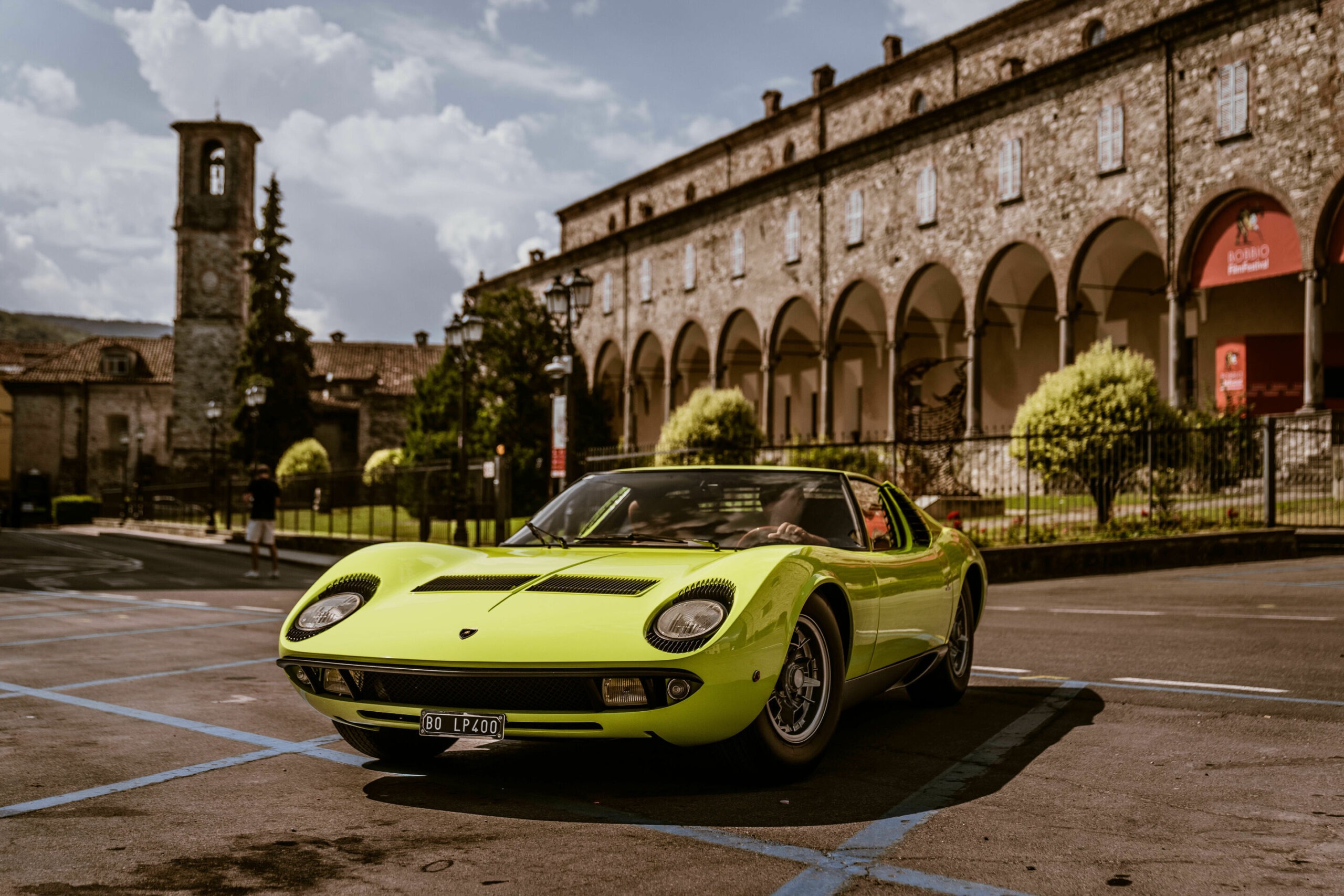
Automobili Lamborghini was founded in May 1963 by Ferruccio Lamborghini, an industrialist who had made his money building tractors from wartime surplus and then heating and air-conditioning systems. In its first six decades the company invented the modern supercar with the Miura, shocked the world with the Countach, went through financial collapse and changed owners five times, before Audi bought it in 1998 and turned it into a stable business. In 2025 Lamborghini delivered a record 10,747 cars worldwide, and 111 of them went to Indian buyers.
What follows is the story in order, with the cars that mattered, the years that nearly ended it, and what it all means for the Lamborghinis you can buy in India today.
Lamborghini timeline at a glance
| Year | Milestone |
| 1963 | Company founded in Sant’Agata Bolognese; 350 GTV prototype shown in Turin |
| 1964 | 350 GT, the first production Lamborghini, debuts at Geneva |
| 1966 | Miura debuts at Geneva, with a transverse mid-mounted V12 |
| 1968 | Espada four-seater and Islero launched |
| 1971 | Countach LP500 prototype stuns the Geneva Motor Show |
| 1972 | Ferruccio sells 51 percent of the company to Georges-Henri Rossetti |
| 1974 | Ferruccio retires; Countach LP400 production begins |
| 1981 | The Mimran Group takes over; Jalpa launched |
| 1986 | LM002, a V12 off-roader, launched |
| 1987 | Chrysler buys Lamborghini |
| 1990 | Diablo replaces the Countach |
| 1994 | Chrysler sells to Indonesian investment fund Megatech |
| 1998 | Lamborghini joins the Audi Group |
| 2001 | Murciélago, the first Lamborghini developed under Audi |
| 2003 | Gallardo V10 launched; Centro Stile design studio opens |
| 2007 | Lamborghini enters India |
| 2011 | Aventador, with a carbon-fibre monocoque |
| 2014 | Huracán replaces the Gallardo |
| 2018 | Urus, the first Lamborghini “Super SUV” |
| 2023 | Revuelto V12 plug-in hybrid; 60th anniversary |
| 2024 | Urus SE plug-in hybrid and Temerario; the range is fully hybrid |
| 2025 | Record 10,747 deliveries worldwide |
Sources: Lamborghini’s official history and milestones pages, Audi press releases on Lamborghini, Autocar Professional (India entry).
1963: Ferruccio Lamborghini decides to build a better GT
Ferruccio Lamborghini was not a car man in the usual sense. According to the company’s own history, he built his first fortune converting military vehicles into tractors after the Second World War, and then expanded into heating and cooling systems in the 1950s. By the early 1960s he was rich, he owned fast cars, and he wanted to build one of his own.
There is a famous story, repeated so often it has become part of the brand, that a disagreement with Enzo Ferrari over the clutch of his Ferrari pushed Ferruccio to compete. Lamborghini’s official account is simpler: he wanted to become a sports car manufacturer in an industry dominated by a handful of brands. Either way, he did it fast.
The company was established in May 1963, and the first section of the factory at Sant’Agata Bolognese, near Bologna, was built in about eight months, according to an Audi press release on the company’s history. On 20 October 1963 he showed the press the 350 GTV, a prototype styled by Franco Scaglione with a 3.5-litre V12 engineered by Giotto Bizzarrini.
The logo came the same year. Lamborghini says it was drawn by a local typographer, Paolo Rambaldi, around the bull of Ferruccio’s zodiac sign, Taurus. The bull, and the habit of naming cars after fighting bulls, has stayed ever since.
The production 350 GT followed at Geneva in 1964, with a more powerful engine tuned by Paolo Stanzani and a body by Carrozzeria Touring. In 1965, the factory built 67 cars.
1966: the Miura creates the supercar
The car that made Lamborghini famous was not Ferruccio’s idea of what the company should build. He favoured refined front-engined grand tourers and, according to the company’s history, did not believe racing helped sell road cars. A young engineering team had other plans.
The Miura debuted at the 1966 Geneva Motor Show with a 4.0-litre V12 mounted transversely behind the cabin and bodywork by Bertone. A mid-mounted engine was racing-car thinking applied to a road car, and the result was low, wide and faster than almost anything else on the road. Lamborghini says the Miura coined the term “supercar”, and it stayed in production in three series until the early 1970s. The name came from a Spanish breed of fighting bull.
Alongside it, Lamborghini kept building the grand tourers Ferruccio preferred: the four-seat Espada and the Islero in 1968, and the Jarama in 1970. By 1971, production had climbed to 425 cars a year.
1971: the Countach, and the shape every supercar still copies
On 11 March 1971, a yellow prototype called the Countach LP500 appeared on Bertone’s space at the Geneva Motor Show. It was styled by Marcello Gandini, Bertone’s design director, with mechanical design led by Paolo Stanzani. “LP” stood for longitudinale posteriore, because the V12 now sat lengthways behind the driver.
The wedge shape, scissor doors and sheer width made the Miura look soft. The prototype itself had a short life. Lamborghini says it was used for crash tests in early 1974 and then scrapped. But the production Countach LP400 went on sale in 1974, and over five series until 1990, 1,999 Countachs were built.
For two decades, the Countach was the poster on every enthusiast’s wall. It is also the car that kept Lamborghini’s name alive while the company itself was in trouble.
1972 to 1998: five owners in 26 years
The years between the Countach’s debut and Audi’s arrival are the part of the story most fans skip. They explain why Lamborghini today is the company it is.
- 1972 to 1974. To strengthen the company’s finances, Ferruccio sold 51 percent of the company to businessman Georges-Henri Rossetti in 1972. In 1974 he retired, and, according to Lamborghini’s milestones, Rossetti and Leimer took over the management.
- The late 1970s. The oil crisis hit V12 supercars hard. By 1979, the factory built just 55 cars in a year, according to Audi’s history release, down from 425 in 1971.
- 1981. The Mimran Group acquired the company and launched the V8 Jalpa. The Countach kept evolving, reaching 5.2 litres and four valves per cylinder in the 1985 Quattrovalvole.
- 1986. The LM002, a V12 off-roader, went on sale. It sold in small numbers, but Lamborghini now calls it a forerunner of the “super SUV”. Remember it: it matters later.
- 1987. Chrysler, led by Lee Iacocca, bought Lamborghini. That year the factory built 470 cars and 300 marine engines. The Diablo, finished under American ownership, replaced the Countach in 1990 with a 5.7-litre V12, and more than 2,900 were built.
- 1994. Chrysler sold Lamborghini to Megatech, an Indonesian investment fund, which held control until 1998.
Our view: these 26 years are the best argument for what happened next. Lamborghini always had the designs and the engines. What it never had, until 1998, was an owner with the money and patience to invest for the long term.
1998 onwards: Audi turns Lamborghini into a business
In 1998 Lamborghini joined the Audi Group, part of Volkswagen. The first product was the third series of the Diablo with a 6.0-litre engine, and then the investment started showing.
In 2000, Lamborghini built 296 cars with 440 employees. By 2003, after a major rebuild of the Sant’Agata site, it built 1,305, according to Audi’s history release. Two cars did most of the work:
- Murciélago (2001). The new flagship V12, with all-wheel drive as standard.
- Gallardo (2003). A smaller, two-seat V10 with all-wheel drive. It was the first Lamborghini that people used more than occasionally, and it became the brand’s first true worldwide success. The Centro Stile design studio opened the same year.
By 2006, production passed 2,000 cars a year. The Aventador (2011) brought a carbon-fibre monocoque developed and built in-house, and the Huracán (2014) replaced the Gallardo with a 610hp V10, a seven-speed dual-clutch gearbox and all-wheel drive.
2018: the Urus changes everything
The Urus launched in 2018 as Lamborghini’s third model line, with a 650hp twin-turbo V8, and the factory at Sant’Agata was extended to build it. Thirty years after the LM002, Lamborghini had another SUV, and this time it was aimed squarely at the people who wanted a Lamborghini they could use every day.
It worked. By 2022 the company delivered 9,233 cars and employed more than 2,000 people. For the first time in its history, Lamborghini was big enough and profitable enough to fund its own future.
The hybrid era: Revuelto, Urus SE and Temerario
In May 2021 Lamborghini announced its Direzione Cor Tauri plan to electrify the whole range. It delivered on it quickly:
- Revuelto (2023): the Aventador’s successor, pairing a naturally aspirated 6.5-litre V12 with three electric motors for a combined 1,015hp.
- Urus SE (2024): a plug-in hybrid twin-turbo V8 with up to 60km of electric range, according to evo India.
- Temerario (2024): the Huracán’s replacement, a hybrid twin-turbo V8 with a combined 907bhp.
In 2025, with a range that was now fully hybrid, Lamborghini delivered a record 10,747 cars and reported revenue of €3.20 billion, the highest in its history, according to its results announcement in March 2026. The company says its hybrids pave the way for a fully electric model later.
From 55 cars in 1979 to more than 10,000 a year: few brands have turned around as completely.
Lamborghini in India
Lamborghini entered India in 2007, according to Autocar Professional. For most of the years since, it sold in very small numbers, but sales have grown fast since the Urus arrived.
| Year | Lamborghini India sales |
| 2023 | 103 cars, the first year above 100 |
| 2024 | 113 cars, a record |
| 2025 | 111 cars |
Sources: Autocar India (January 2026) and Autocar Professional (2024 figures).
Two things stand out. First, the Urus is the brand’s mainstay here. Lamborghini’s chairman and CEO, Stephan Winkelmann, told Business Standard in March 2025 that about half of India sales were Urus SUVs and half were super sports cars. Second, Indian Lamborghini buyers are young. In the same interview, he said they are generally under 40, among the youngest customers the brand has, with only China younger in Asia-Pacific.
Lamborghini prices in India (October 2026)
| Model | Powertrain | India launch | Ex-showroom |
| Urus SE | 4.0 twin-turbo V8 plug-in hybrid | August 2024 | Rs 4.57 crore |
| Temerario | 4.0 twin-turbo V8 hybrid | April 2025 | Rs 6.00 crore |
| Revuelto | 6.5 V12 plug-in hybrid | December 2023 | Rs 8.89 crore |
Prices from Autocar India’s Lamborghini listing (updated 17 September 2026) and launch reports in Autocar India and evo India. All prices are before personalisation, which is where most Indian Lamborghinis end up costing a lot more.
Autocar India lists a Revuelto Roadster as expected in India in late 2026, but there is no confirmed launch date.
What Lamborghini’s history means if you’re buying one
History is not just trivia here. It explains why used Lamborghinis behave differently from one era to the next:
- Post-2003 cars are the usable ones. The Gallardo, Huracán and Urus were all developed under Audi, with Audi-era parts sharing, quality systems and dealer support. That is why they make up most of the pre-owned Lamborghinis you will see in India.
- The Urus is the volume car, so it is the volume used car. With about half of India sales going to the Urus, it is also the most common Lamborghini on the pre-owned market. Expect more choice and more price competition than for a Huracán or a V12.
- Hybrids change the ownership equation. The Revuelto, Urus SE and Temerario all carry high-voltage batteries. On a used example, ask an authorised Lamborghini dealer to confirm the hybrid system’s warranty status and service history against the car’s VIN.
You can browse pre-owned Lamborghinis listed on Motozite, and compare them with other ultra-luxury cars above Rs 2 crore. If brand history is your thing, our story of Mercedes-Benz’s journey to luxury leadership is a good companion read.
FAQ
Who founded Lamborghini and when?
Ferruccio Lamborghini founded Automobili Lamborghini in May 1963 in Sant’Agata Bolognese, near Bologna in Italy. He had earlier built a business converting military vehicles into tractors and then making heating and cooling systems. The first Lamborghini, the 350 GTV prototype, was shown to the press in October 1963.
What was the first Lamborghini car?
The first Lamborghini was the 350 GTV prototype, shown in October 1963 with a 3.5-litre V12. The first production car was the 350 GT, which debuted at the Geneva Motor Show in 1964.
Why is the Lamborghini Miura called the first supercar?
The Miura, launched at the 1966 Geneva Motor Show, put a V12 engine in the middle of a road car, behind the driver, as racing cars did. Lamborghini says the Miura coined the term “supercar”, and its mid-engine layout became the template for most supercars that followed.
Who owns Lamborghini now?
Lamborghini has been part of the Audi Group, and therefore Volkswagen, since 1998. Before that it was owned by Ferruccio Lamborghini, then Georges-Henri Rossetti and Leimer, the Mimran Group, Chrysler and the Indonesian investment fund Megatech.
When did Lamborghini come to India?
Lamborghini entered India in 2007. Its India sales crossed 100 cars a year for the first time in 2023 (103 cars), reached a record 113 in 2024 and were 111 in 2025, with the Urus accounting for about half of sales.
What is the cheapest Lamborghini in India?
The Lamborghini Urus SE is the most affordable Lamborghini in India at Rs 4.57 crore ex-showroom, as of October 2026. The Temerario costs Rs 6.00 crore and the Revuelto Rs 8.89 crore, before personalisation options.
