
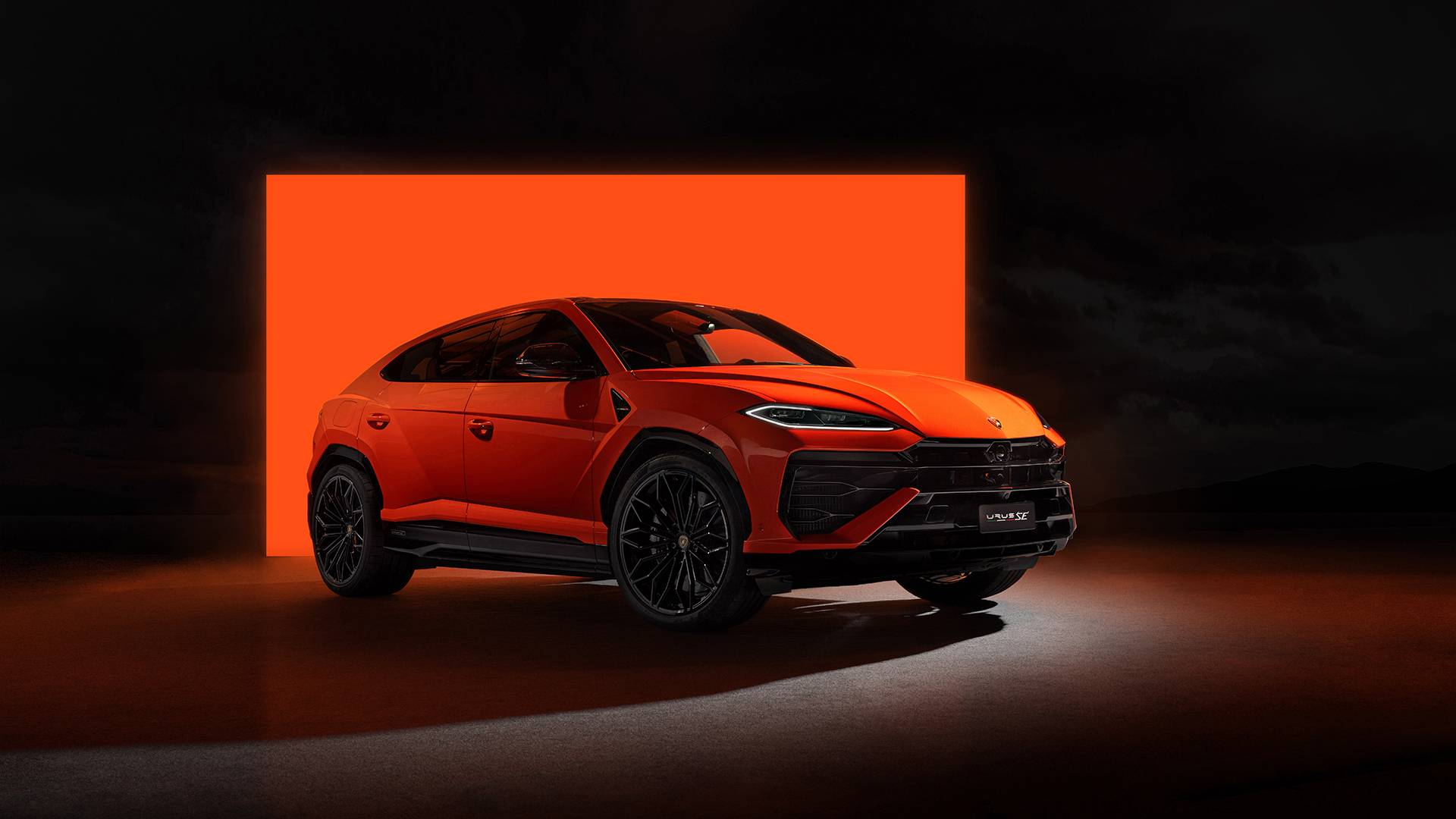
The Lamborghini Urus SE is the best Urus yet, and also the hardest one to justify buying in India right now. It is a plug-in hybrid with a 4.0-litre twin-turbo V8 and an electric motor, 800hp in total, 0 to 100km/h in 3.4 seconds and up to 60km of electric-only driving. It launched in India in August 2024 at Rs 4.57 crore ex-showroom, which works out to about Rs 5.32 crore on the road in Delhi. The car is excellent. The problem is timing. The India-EU trade agreement will cut import duty on many European petrol cars from 2027 or 2028, but it leaves out plug-in hybrids, and every Lamborghini is now a plug-in hybrid. Buy an Urus SE if you want one now and will keep it for years. If you are on the fence, read the section on price before you book.
Lamborghini Urus SE at a glance
| Specification | Urus SE |
| Engine | 4.0-litre twin-turbo V8 |
| V8 output | 620hp, 800Nm |
| Combined output | 800hp, 950Nm |
| Battery | 25.9kWh lithium-ion |
| Electric-only range | 60km (WLTP), up to 130km/h in EV mode |
| 0-100km/h | 3.4 seconds (claimed) |
| Top speed | 312km/h (claimed) |
| Kerb weight | 2,505kg |
| Boot | 454 litres |
| Charging | 4.2 hours, 20 to 100 percent, on a 7.2kW AC charger |
| Price (ex-showroom, launch) | Rs 4.57 crore |
| On-road price | Rs 5.32 crore (Delhi), Rs 5.46 crore (Mumbai) |
Sources: Lamborghini, Autocar India (launch report, specification page, 30 August 2026 review), evo India. Autocar India’s August 2026 review and a March 2026 BizzBuzz report quote Rs 4.47 crore ex-showroom, while Autocar India’s model page (updated 22 October 2026) still lists Rs 4.57 crore. Confirm the current price with your dealer.
What the Urus SE replaced, and why it matters
The Urus arrived in India in 2018 and quickly became Lamborghini’s volume car here. Rushlane reported in March 2025 that it made up about half of the brand’s Indian sales. The SE replaced both the Urus S and the harder-edged Performante, so for the last two years it has been the only Urus you could buy new in India.
That makes it more than a new variant. It is Lamborghini’s bet that its most popular car can go hybrid without losing its character. On the evidence of Autocar India’s drive, it largely has.
Performance: faster than ever, a little less savage
The numbers settle the speed question. Autocar India’s August 2026 review recorded Lamborghini’s claim of 3.4 seconds to 100km/h and 11.2 seconds to 200km/h, with a 312km/h top speed. The electric motor sits inside the eight-speed gearbox and fills the gaps while the turbos spool.
What changes is the character. Autocar India’s reviewer found the SE more refined and calm when driven gently, with real fury held back for Sport and Corsa, but felt it is not as brutal as the older Urus. He also found the V8 sounds more subdued from inside, and was not a fan of engine sound being piped through the speakers.
Our view: for most Indian owners, who will spend far more time in Mumbai traffic than on the Buddh International Circuit, a calmer Urus is an improvement. If you specifically want the old car’s aggression, the answer is the Urus SE Performante, revealed on 1 July 2026 with 812hp, 1,000Nm and 32kg less weight. Lamborghini has not confirmed when it will reach India.
Electric mode: genuinely useful in Indian cities
This is where the SE makes the most sense here. Lamborghini claims 60km of electric-only range on the WLTP cycle, and the SE can run on electricity alone at up to 130km/h. Autocar India’s reviewer felt short daily trips could often be done without starting the V8.
For a car that typically does school runs, office commutes and evening drives inside a city, that is a real change. A Delhi or Bengaluru owner who charges overnight could use the V8 mostly on weekends.
Two caveats. First, you need somewhere to charge. Autocar India lists 4.2 hours for a 20 to 100 percent charge on a 7.2kW AC charger, which means a home wallbox. Our guide to home EV chargers for luxury cars covers the cost and the society NOC question. Second, if you never plug it in, efficiency falls hard. Autocar India quotes 7.75km/l with a depleted battery, so a flat Urus SE is a thirsty Urus.
There is also a ‘Recharge’ mode that uses the engine to charge the battery to 80 percent while you drive, according to Autocar India’s launch report. Useful before you reach a city, but it burns fuel to do it.
Interior, practicality and features
The SE got Lamborghini’s newer interior: revised dashboard and vents, new seats, and a 12.3-inch central touchscreen, up from 10.1 inches, running software from the Revuelto. Autocar India’s reviewer liked the larger screen but found its sub-menus confusing to navigate.
Practicality is better than the badge suggests. The boot holds 454 litres, which Autocar India calls the most practical of any Lamborghini. The rear seat has plenty of legroom and is wide enough for three, though taller passengers may find headroom tight under the sloping roof. If you are over six feet and expect to sit in the back, try it before you buy.
Standard kit includes wireless Android Auto and Apple CarPlay, a 360-degree camera, four-zone climate control and Lamborghini’s telemetry system. But at this price, several things you might assume are standard, including the panoramic sunroof and the Bang & Olufsen 3D audio, cost extra. Budget for options, because the ex-showroom price is a starting point, not what most buyers end up paying.
Ride and Indian roads
Lamborghini’s chief marketing and sales officer, Federico Foschini, told evo India in August 2026 that the Urus suits Indian roads, which can be tough in some cities. That is true up to a point.
Autocar India found the ride pliant at low speeds, firming up as you go faster, with the 23-inch wheels sending sharp potholes through to the cabin without making it uncomfortable. Bear in mind that its review was not a dedicated test on Indian roads. Autocar India’s specification page lists ground clearance at about 158mm with the air suspension. So treat speed breakers and steep building ramps with care, and check your basement before you buy. The air suspension is also a component to watch at higher mileage; our guide to air suspension problems in luxury cars explains the warning signs.
Weight is the other thing to remember. At 2,505kg, the SE is heavy, and the carbon-ceramic brakes (440mm at the front) work hard. Autocar India found they take some getting used to but stop consistently.
Price, rivals and the trade-deal problem
Here is how the Urus SE compares on ex-showroom price with the other ultra-luxury SUVs sold in India, as listed by Autocar India:
| SUV | Ex-showroom price | Powertrain | Built in |
| Bentley Bentayga EWB | From Rs 4.20 crore | V8 petrol | UK |
| Lamborghini Urus SE | Rs 4.57 crore | V8 plug-in hybrid | Italy |
| Aston Martin DBX707 | Rs 5.89 crore | V8 petrol | UK |
| Ferrari Purosangue | Rs 7.59 crore | V12 petrol | Italy |
Sources: Autocar India listings, updated 6 October 2026 (Bentley, Aston Martin), 22 October 2026 (Lamborghini) and 28 September 2026 (Ferrari). Autocar India’s DBX page shows two different price figures; Rs 5.89 crore is the one it labels ex-showroom.
The Ferrari line is the one to look at. Business Today reported in May 2026 that Ferrari dealers were already taking Purosangue orders at a price linked to the India-EU free trade agreement, and Autocar India says deliveries at that lower price depend on the agreement taking effect.
The Urus SE does not get that benefit. Lamborghini’s chairman and CEO Stephan Winkelmann said in March 2026 that the agreement excludes plug-in hybrids, so Lamborghini will not gain from it. In August 2026 he told Autocar India that Lamborghini was seeing a drop in India because of uncertainty over how plug-in hybrids will be taxed, and that he expects clarity to take about four years. Foschini put the price gap between petrol cars that qualify for the cut and plug-in hybrids that do not at 40 percent.
What this means for a buyer, in our view:
- The Urus SE’s rivals may get cheaper; the Urus SE probably won’t, for years. If you are cross-shopping a European petrol SUV, wait for its post-agreement price before deciding.
- Resale is the open question. If a petrol Purosangue drops sharply in price, that changes what the ultra-luxury SUV market will pay for a used Urus SE too. Nobody can predict it precisely, so factor in some risk if you plan to sell within three years.
- Negotiating position. Rushlane reported in March 2025 that Urus order books were full for the next 18 months. Eighteen months later, with the CEO talking about a drop in India, a buyer is likely in a stronger position than before. Ask about options packages and delivery dates in writing.
New Urus SE or a used Urus?
Lamborghini sold 111 cars in India in 2025, down from 113 in 2024, according to Siasat’s report of the company’s annual results, and close to 800 Lamborghinis are now on Indian roads. That means a small but real used market. On 24 October 2026, Motozite’s pre-owned Lamborghini page had a 2018 Urus V8, second owner, 33,000km, listed at Rs 2.75 crore. That is roughly half the Urus SE’s on-road price, for a car with the same basic shape and a non-hybrid V8.
If you want the Urus experience and don’t need the hybrid’s electric range, a well-documented first-generation car is the rational choice. If you want the newest car, the electric mode and the latest interior, buy the SE. Our pre-owned Porsche Macan and Cayenne ownership guide covers the inspection and running-cost questions that apply to any used performance SUV.
Verdict: should you buy the Lamborghini Urus SE in India?
Buy it if you want the most complete Urus Lamborghini has built, will use the electric range in town, have a place to charge, and plan to keep the car long enough that the trade-agreement question stops mattering. It is faster, calmer and more usable than the car it replaced.
Hold off if you are weighing it against a European petrol rival, or if you are buying with a short resale horizon. In India, in late 2026, the Urus SE is a great car with an awkward price story.
For the full background on the brand, read our history of Lamborghini, or compare it with other big-ticket SUVs in our list of the most expensive luxury SUVs in India.
FAQ
What is the price of the Lamborghini Urus SE in India?
The Urus SE launched in India in August 2024 at Rs 4.57 crore ex-showroom, and Autocar India lists on-road prices of about Rs 5.32 crore in Delhi and Rs 5.46 crore in Mumbai. Some recent reports quote Rs 4.47 crore ex-showroom, and options add significantly, so confirm the current price with a Lamborghini dealer.
Is the Lamborghini Urus SE a hybrid?
Yes. The Urus SE is a plug-in hybrid. It combines a 4.0-litre twin-turbo V8 making 620hp with an electric motor and a 25.9kWh battery, for a combined 800hp and 950Nm. It can run on electricity alone for up to 60km (WLTP) at speeds up to 130km/h.
How fast is the Lamborghini Urus SE?
Lamborghini claims 0 to 100km/h in 3.4 seconds and a top speed of 312km/h. Autocar India’s review also quotes 0 to 200km/h in 11.2 seconds. The new Urus SE Performante, revealed in July 2026, is quicker still at a claimed 3.3 seconds.
How long does the Urus SE take to charge?
Autocar India lists 4.2 hours to charge the battery from 20 to 100 percent on a 7.2kW AC charger. That makes a home wallbox the practical option. The car also has a Recharge mode that uses the engine to charge the battery to 80 percent while driving.
Will the Urus SE get cheaper after the India-EU trade deal?
Unlikely in the near term. Lamborghini’s CEO Stephan Winkelmann said in March 2026 that the agreement excludes plug-in hybrids, which covers every current Lamborghini, and in August 2026 he said he expects clarity on plug-in hybrid taxation to take about four years.
What is the mileage of the Urus SE?
Autocar India quotes a WLTP combined figure of 7.75km/l with a depleted battery. With a charged battery, real-world fuel use in town can be much lower, because short trips can be done on electric power alone.
