
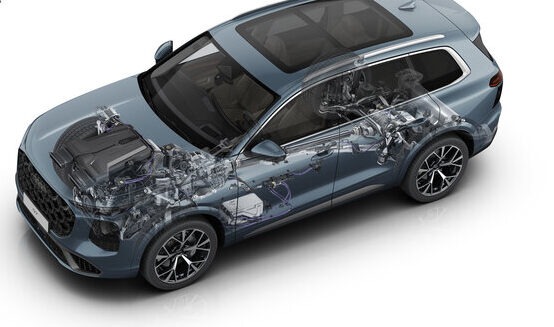
Air suspension rarely fails without warning. A car that sits lower at one corner after a night parked, a compressor that runs longer or louder than it used to, a “suspension fault” message, or a ride that has suddenly turned harsh are the usual early signs on a Range Rover, an Audi Q7, or a Mercedes S-Class or GLS. Catch them early, and the fix can be a sensor, a wire, or an air line. Ignore them and a leak can kill the compressor too, and Indian owners have reported bills of several lakh rupees when struts go on an older car.
This guide covers how the system works, the faults that come up most, what Indian owners have actually paid, and how to check a pre-owned car before you buy it.
Which luxury cars in India use air suspension?
Air suspension is standard or available across a big slice of the luxury market, so this is not a niche worry. A few current examples, from Autocar India’s specification pages and launch coverage:
| Brand | Models with air suspension in India (current) |
| Land Rover | Range Rover, Range Rover Sport, Range Rover Velar Autobiography (the Velar Dynamic SE uses coil springs) |
| Audi | Q7, as standard since the February 2022 facelift (adaptive air suspension) |
| Mercedes-Benz | GLS (air springs front and rear), S-Class (adaptive air suspension, which Mercedes calls AIRMATIC) |
On the pre-owned market, the list is longer because older generations of these cars, and several flagship sedans, used air springs too. If you are unsure, check the variant’s specification sheet or ask the brand’s workshop to confirm from the VIN.
How air suspension works, in one minute
Instead of steel coil springs, each corner sits on a rubber air spring (often called a bellow or air bag), usually built into a strut with the damper. An electric compressor pumps air into the springs, a valve block decides which corner gets air, height sensors tell the control unit where each corner is, and many systems keep a reservoir of pressurised air for quick changes.
A detailed Team-BHP explainer from November 2023, based on a Jaguar workshop manual (Land Rover uses a closely related system), adds two details worth knowing. The compressor is air-cooled and has a timer cut-out to stop it overheating, so a system with a leak can push it to its limits. And check valves in each strut hold a minimum pressure, so a car with a dead compressor typically settles onto its struts but can still be driven slowly, with a noticeably harsher ride.
The upside on Indian roads is real: you can raise the car for a steep speed breaker or a flooded street, and lower it at speed for stability. The downside is that you now have air lines, rubber springs, a compressor, sensors and software where a coil car has a lump of steel.
The six warning signs
- The car sinks overnight. Park on level ground, note the gap between the tyre and the wheel arch at each corner, and check again in the morning. One corner noticeably lower points to a leak in that spring or its air line. All four lower points more towards the valve block or the reservoir.
- The compressor runs too often or too long. You’ll hear it whirring after start-up or at a standstill. A healthy system tops up briefly. A compressor that keeps running is chasing a leak, and it will wear itself out doing so.
- A warning message. Range Rovers can show a “Suspension Height Fault” message, and Audi and Mercedes have their own level-control warnings. Don’t clear it and carry on. Get it scanned.
- The car won’t change height. If the raise or access modes are slow or don’t respond, the compressor or reservoir is struggling.
- A harsh, crashy ride. A spring that has lost pressure, or a car sitting on its bump stops, rides like a truck over expansion joints.
- Uneven stance or leaning. One side sitting lower at a standstill, or the car leaning after a turn, suggests a corner is not holding pressure.
A seventh one catches people out: odd faults after a weak battery. On a Team-BHP thread about a Velar in October 2026, a member pointed out that low 12V battery voltage can trigger unexplained warnings on modern luxury cars. If suspension and other electrical warnings appear together, have the battery tested before you start replacing parts.
What actually fails, and what it costs in India
Indian-market repair data is thin, because dealers don’t publish part prices and most owners only share costs when something goes badly wrong. Here is what the failures are and what owners have reported.
| Component | What goes wrong | What Indian owners have reported |
| Height sensor or its wiring | False readings, height faults, harsher ride, no sagging | A Range Rover Sport P400e owner on Team-BHP (April 2026) had a “Suspension Height Fault” traced to damaged wiring on the front-left height sensor. He called it an easy but expensive fix, without sharing the bill. |
| Air spring (bellow) | Rubber perishes or cracks, dust boots tear, slow leak, car sinks | Team-BHP’s 2023 explainer lists bellows among the most common failures. A specialist in that thread replaces only the bellow on a strut, which is far cheaper than a complete new strut. |
| Complete strut | Leak plus worn damper, usually at age | A W221 Mercedes S350 owner on Team-BHP (March 2022), with a car nearly ten years old, estimated about Rs 2.5 lakh per strut and roughly Rs 12 lakh in total to replace all four with related parts. In a 2023 thread, another member estimated about Rs 1 lakh per corner in the aftermarket for an S-Class. |
| Compressor | Worn out, often by a long-running leak | In the same 2023 explainer, an original Jaguar compressor was quoted at around 3,000 euros in Europe, before any import costs. |
| Valve block, air lines, reservoir, pressure switch | Leaks at joints, sticking valves, switch failure shutting the system down | Members flag the pressure switch and lines as weak points. Usually cheaper parts, but diagnosis takes time. |
Two practical points follow from this. First, the cheapest repair is the one done early: a leaking air line or a sensor caught at the warning-light stage stops the compressor from burning out. Second, imported parts can take time. A Team-BHP owner who imported rear struts for his S-Class in 2021 ran into a customs hold of more than two weeks.
We have deliberately not published a “typical dealer price” per brand. Prices vary by model, generation, and city, and we could not find current, published Indian figures from a source we trust. Ask the brand’s workshop for a written, part-numbered quote, and ask an established independent specialist to quote the same job.
Range Rover, Audi or Mercedes: is one worse?
We have not found Indian data that ranks the three brands on air suspension reliability, and we wouldn’t trust anyone who claims to. What we can say:
- Range Rover: every Range Rover and Range Rover Sport sold today uses air springs, and so does the Velar Autobiography, so most pre-owned Range Rovers you look at will have them. Team-BHP’s explainer notes that Land Rover’s system is closely related to Jaguar’s. The recent Indian owner reports we found were about height-sensor wiring and electrical faults rather than burst springs, which fits newer cars; spring and compressor wear is the bigger worry as they age.
- Audi’s air suspension is standard on the Q7, so every pre-owned petrol Q7 from 2022 onwards has it. On any older air-sprung Audi, treat the suspension as an inspection item, not a footnote.
- Mercedes owners of older S-Class models have posted the most detailed cost stories on Indian forums, and the W221 case above shows the scale of the bill on a ten-year-old car.
The real variable is age and history, not the badge. A five-year-old car with a full dealer history is a very different risk from a ten-year-old car that has changed hands three times.
Before you buy a pre-owned car with air suspension
This is where most of the money is saved or lost.
- Do the overnight test. Ask to see the car after it has been parked overnight, and measure all four corners. Our pre-owned Audi buying guide uses the same check on the Q7.
- Cycle through every height setting from access height to the highest off-road or raised setting, and time how long each change takes. Listen for the compressor.
- Get a full diagnostic scan at the brand’s workshop. Stored suspension faults, even cleared ones, tell you a lot.
- Ask for the suspension history. Which struts, springs, or compressors have been replaced, when, and whether the parts were original, aftermarket, or refurbished.
- Check the warranty position. Land Rover India’s standard warranty runs 3 years or 1,00,000km. Audi India offers extended warranty up to 10 years from first sale and 2,00,000km, bought before the existing cover runs out. Whatever the brand, ask in writing whether air suspension parts are covered, and whether cover transfers to you.
- Price in a reserve. On an out-of-warranty car more than seven or eight years old, our view is that you should either budget for at least one strut and a compressor or negotiate the asking price down by that much.
For everything else on a used luxury car, use our inspection checklist.
How to make air suspension last
- Raise the car before a steep speed breaker, and cross it slowly. Scraping the underbody or crashing onto the bump stops is hard on the springs.
- Don’t leave the car at access height when parked for long periods.
- Keep the 12V battery healthy. If the car sits unused for weeks, use a battery maintainer. Our post on why luxury car batteries drain fast explains why.
- Have the compressor’s filter and moisture trap checked at services if your car’s schedule includes them. Team-BHP’s explainer calls this the main routine maintenance a healthy system needs.
- Use a workshop that knows the system for wheel alignment. Many air-sprung cars need a special mode so the car sits at the right height on all four springs during alignment.
- Act on the first warning. A sensor or air-line repair now costs far less than a compressor that has worn itself out chasing a leak.
What about converting to coil springs? Some owners of older cars fit coil conversion kits to avoid air suspension costs for good. You lose height adjustment and some ride comfort; the car may show permanent warnings unless it is recoded, and it narrows your pool of buyers when you sell. On a car you plan to keep for its last few years, it can make sense. On anything you intend to resell, we would repair rather than convert.
Our take
Air suspension is not a reason to avoid a Range Rover, a Q7 or an S-Class. On Indian roads, it is one of the best things about them. It is a reason to buy carefully, budget honestly, and treat a warning light as a phone call to the workshop rather than something to clear and forget.
If you are shopping, compare pre-owned luxury SUVs and sedans on Motozite, and look at demo cars if you would rather start with something still under factory warranty.
FAQ
What are the signs of air suspension failure?
The most common signs are the car sitting lower at one or more corners after being parked, the compressor running often or for a long time, a suspension warning on the dashboard, the car not changing height when asked, and a suddenly harsh ride. One corner sagging overnight usually points to a leak in that corner’s air spring or air line.
How much does air suspension repair cost in India?
It depends on what has failed. A sensor, wire, or air line can be a modest repair, while a complete strut is expensive: one Mercedes S-Class owner on Team-BHP estimated about Rs 2.5 lakh per strut and around Rs 12 lakh to replace all four with related parts on a ten-year-old car. Refurbishing a strut by replacing only the air spring is usually much cheaper. Always get a written, part-numbered quote from the brand’s workshop and compare it with an established independent specialist.
Can I drive a car with failed air suspension?
Often, slowly and for a short distance. Many systems hold a minimum pressure in each strut, so a car with a failed compressor usually settles low but can still move, with a harsh ride and reduced ground clearance. If a corner has dropped onto its bump stop or a warning tells you not to drive, have the car towed rather than risk damaging the tyres, body or other suspension parts.
Which luxury cars in India have air suspension?
Current examples include the Range Rover, Range Rover Sport and Range Rover Velar Autobiography, the Audi Q7, and the Mercedes-Benz GLS and S-Class. The Velar Dynamic SE uses coil springs. Many older generations of luxury SUVs and sedans also used air suspension, so confirm the specification of any pre-owned car before you buy.
Is air suspension covered by warranty in India?
Under the manufacturer’s standard warranty, a defective air suspension part should be covered, for example, within Land Rover India’s 3 years or 1,00,000km. Extended warranties vary by brand and plan, so ask in writing whether air springs, compressors, and sensors are included, and whether the cover transfers to a second owner.
How do I check air suspension on a used car?
See the car after it has been parked overnight and measure the height at all four corners. Then cycle through every height setting, listen to the compressor, and get a full diagnostic scan at the brand’s workshop to check for stored suspension faults. Ask for records of any struts, springs or compressors replaced.
