
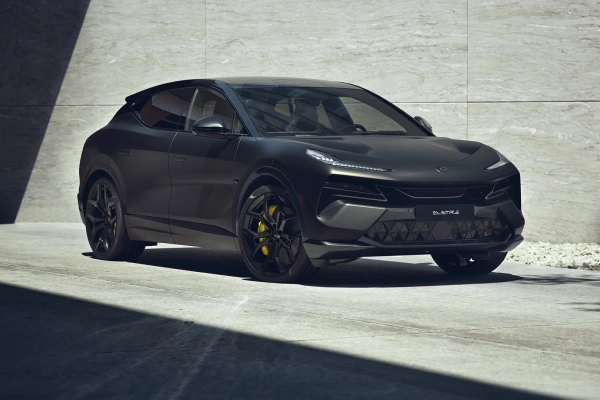
The Lotus Eletre is a fast, rare and properly luxurious electric SUV, priced in India from Rs 2.55 crore to Rs 2.99 crore ex-showroom. It’s easy to like and harder to recommend than it was at launch. In 2023 it was close to a class of one. Now the Porsche Cayenne Electric Turbo costs Rs 2.27 crore, makes more power and has a larger network behind it. Our view: buy the Eletre only if its rarity and design matter to you, and in that case choose the Eletre S on 22-inch wheels, not the headline-grabbing R.
A note on this review: it combines the published India drives by Autocar India, Car India and Turbocharged with current specifications and ownership data. All three drives date from December 2023 to March 2024, so check software-related points on a current car.
Lotus Eletre price in India
Lotus launched the Eletre here on 9 November 2023. Three years later, Autocar India’s listing shows the same ex-showroom prices.
| Variant | Ex-showroom | Autocar India’s Delhi estimate | Power | Claimed range |
| Eletre | Rs 2.55 crore | Rs 2.72 crore | 603hp | Up to 600km |
| Eletre S | Rs 2.75 crore | Rs 2.93 crore | 603hp | Up to 600km |
| Eletre R | Rs 2.99 crore | Rs 3.18 crore | 905hp | 490km |
Sources: Autocar India price page (12 October 2026) and launch report (9 November 2023).
Check the on-road figure. Autocar India’s Delhi estimate shows Rs 0 for road tax, with insurance of about Rs 14 lakh to Rs 16.4 lakh and other charges of about Rs 2.6 lakh to Rs 3 lakh. But Delhi’s EV Policy, in force from 1 July 2026, limits the road tax and registration waiver to battery EVs priced at Rs 30 lakh or less. If that applies to the Eletre, the real Delhi figure will be higher. The rules vary by state, so get a written on-road quote before you pay a booking amount.
The Eletre is built in Wuhan, China, by Lotus’s Geely-backed business and arrives as a full import. Our reading is that the India-EU and India-UK trade deals won’t help its price, because the car doesn’t come from either region.
Which Lotus Eletre should you buy?
The base car and the S share the same 603hp, 710Nm dual-motor setup. Lotus says that’s enough for 0-100kph in 4.5 seconds. The R adds an uprated rear motor with a two-speed gearbox, for 905hp, 985Nm and a claimed 2.95 seconds.
We’d pick the Eletre S. It costs Rs 20 lakh more than the base car, and Autocar India’s listing shows extras including individual rear chairs, a head-up display, matrix LED headlights and ambient lighting. Its 22-inch wheels and 600km claim are better suited to Indian ownership than the R’s specification.
The R costs Rs 24 lakh more than the S, and for that you give up 110km of claimed range. Autocar India’s Shapur Kotwal felt slightly car sick after repeated launches, and Turbocharged had to cut full-throttle runs short on local roads. Those are thrilling stories, but we doubt you’d use that performance often on an Indian road.
How it drives
Straight-line speed is the headline. Autocar India said the R “feels even quicker” than its 2.95-second claim, and there’s a noticeable shunt around 110kph as the two-speed gearbox shifts. At more than 2.6 tonnes, it also corners with a composure that physics shouldn’t allow. Rear-wheel steering and active anti-roll bars make it feel smaller, and Car India found it could manage three-point turns on narrow roads with ease.
Our rear-wheel steering explainer covers why this helps in basements and old-city lanes.
Don’t expect it to feel like an Elise, though. Autocar India said it feels “more like a Porsche”, specifically the Taycan, than a Lotus, with less communicative steering and less crisp turn-in than the brand’s smaller cars. Turbocharged rated the steering more highly and called it communicative, so try it yourself. Both agree on the bigger picture: it’s accomplished, heavy and complex, and it’s a long way from the lightweight Lotus idea.
Autocar India also found that the driver-assistance systems intervened often and were hard to switch off. That’s a bigger problem in Indian traffic than in Europe, so test it on a busy road.
Ride and Indian roads
The three India drives differ a little here, but the lesson is the same: avoid the 23-inch wheels.
Autocar India found the 23-inch wheels made the low-speed ride stiff, though it improved with speed. Turbocharged said the car rides well but warned that these wheels are easy to damage on Indian roads. Car India called the ride “superb” considering the low-profile tyres, but said Track mode was a poor match for our roads. Tour is the comfortable setting, and Sport is the best all-rounder.
Autocar India’s specification page lists 194mm of ground clearance and height-adjustable air suspension, which should help on speed breakers. Air suspension is also a component to watch as the car ages; our air suspension guide explains why.
Size is the other daily issue. The Eletre is about 5.1 metres long with a wheelbase of 3,019mm, and Autocar India lists its width at 2,231mm. Measure your basement ramp and parking bay before anything else.
| Specification | Lotus Eletre |
| Battery | 112kWh, 800V |
| Length / wheelbase | 5,103mm / 3,019mm |
| Height / ground clearance | 1,636mm / 194mm |
| Kerb weight | From 2,640kg |
| Boot | 688 litres (five-seater), 611 litres (four-seater) |
| DC charging | 10-80% in about 20 minutes at 350kW |
| AC charging | About 5.8 hours, 0-100% at 22kW |
Sources: Autocar India specifications page and December 2023 review.
Interior and rear seat
The cabin is where the Eletre earns much of its price. Autocar India rated the materials and fit-and-finish as first-class, with metal buttons and a real sense of space. The front seats get heating, cooling and massage, and the audio system on the reviewed R was a 23-speaker KEF setup.
The rear is roomy, with what Autocar India called “acres” of space. But the seats feel sporty rather than limousine-like. Car India strongly recommended the four-seater over the five-seater, and we agree. If you’re chauffeured often, sit in the back of both before choosing, and note that a BMW i7 or Mercedes EQS SUV is the more natural rear-seat car.
The weak spot is the software and switchgear. Autocar India found the central screen poorly integrated and not intuitive, disliked the plastic-feeling paddles, and criticised the many steering-wheel shortcuts. The early test cars also lacked Apple CarPlay and Android Auto, which Lotus had promised through an update. We couldn’t confirm their status on current India cars, so check this in the showroom.
Range, charging and battery warranty
Treat the claims as a ceiling. Autocar India said hard driving in the R could cost 100km or more of its 490km claim. On a long trip, plan around much less than the brochure figure until you’ve seen your own numbers.
The 800V system charges very quickly, but only if you find the right charger. When Autocar India tested the car in 2023, no 350kW chargers were available here. That is starting to change: Volvo and ChargeZone opened a 360kW hub near Igatpuri on the Mumbai-Nashik highway in 2026. These sites are still uncommon, so home charging will do most of the work. The 22kW AC rate needs a suitable wall-box and power supply at home.
Lotus India’s warranty cover is strong: five years or 1.5 lakh km on the car, and eight years or 2 lakh km on high-voltage parts, with at least 70% battery state of health guaranteed. That’s a real comfort on a low-volume import. Ask whether it transfers fully to a second owner.
Ownership: the question to settle first
Lotus India is a small operation. Exclusive Motors, which also sells Bentley, is the distributor and retailer, and its first Lotus showroom was due to open at the World Trade Centre in New Delhi in November 2024. We couldn’t confirm a full service network from Lotus’s India locator, so ask where the nearest authorised repairer is and how a car from your city would get there.
The global picture matters too. Lotus Technology’s deliveries fell 46% to 6,520 in 2025, and only 314 of those were outside China, Europe and North America. Lotus has also added a range-extender hybrid, the Eletre X, which its chief executive linked to weaker EV demand than expected. We found no India announcement for it.
None of this means you shouldn’t buy one, but it affects resale. Any Eletre will be hard to value in a thin used market, where few buyers will be shopping for one. We’d assume steep depreciation and be pleasantly surprised if we’re wrong. Our luxury EV resale guide shows how the wider segment behaves.
Lotus Eletre vs rivals
| Car | Ex-showroom | Power | Claimed range | Body |
| Porsche Cayenne Electric | Rs 1.77 crore | 442hp | Up to 642km (WLTP) | Electric SUV |
| Porsche Cayenne Electric Turbo | Rs 2.27 crore | 1,156hp | Up to 623km (WLTP) | Electric SUV |
| Lotus Eletre S | Rs 2.75 crore | 603hp | Up to 600km | Electric SUV |
| Lotus Eletre R | Rs 2.99 crore | 905hp | 490km | Electric SUV |
| Lamborghini Urus SE | Rs 4.57 crore | 800hp | 60km electric | V8 plug-in hybrid |
Sources: Car India (Cayenne Electric, 1 November 2026), Autocar India (Eletre, Urus SE). Porsche power is the Launch Control figure.
The Cayenne Electric Turbo is the problem. It’s Rs 72 lakh cheaper than the Eletre R, quicker on paper at 2.5 seconds to 100kph and has the longer claimed range. In our view it’s the rational choice in this price band, and our Cayenne Electric debut guide has the detail.
The Eletre’s best argument now is against the Lamborghini Urus SE. At Rs 1.58 crore less, the R gives you more power and similar presence. It lacks the V8 and the badge, of course, and those are much of what an Urus buyer pays for.
Our verdict
The Eletre deserves more respect than its low profile suggests. It’s quick, well-finished and far more interesting to look at than the German alternatives. You’ll also rarely park beside another one.
But we’d only buy it with eyes open. Choose the S with 22-inch wheels and the four-seat cabin, and confirm your service route, on-road price and CarPlay support in writing. If you simply want the best electric performance SUV for the money, buy the Porsche.
Lotus isn’t listed on Motozite at the moment, but you can compare pre-owned luxury EVs listed by sellers on the site. Our used luxury EV battery checklist will help if you go that way.
FAQ: Lotus Eletre in India
What is the price of the Lotus Eletre in India?
The Lotus Eletre costs Rs 2.55 crore ex-showroom, the Eletre S Rs 2.75 crore and the Eletre R Rs 2.99 crore, as listed by Autocar India in October 2026. Autocar India estimates Delhi on-road prices of Rs 2.72 crore to Rs 3.18 crore, but that estimate shows no road tax. Ask the dealer for a written on-road quote.
What is the real-world range of the Lotus Eletre?
Lotus claims up to 600km for the Eletre and Eletre S and 490km for the R. Autocar India said hard driving could take 100km or more off the R’s figure. We found no published India range test, so treat the claimed figures as a best case.
How fast does the Lotus Eletre charge?
On a 350kW DC charger, the Eletre goes from 10% to 80% in about 20 minutes. Such chargers are still rare in India. On a 22kW AC charger, a full charge takes about 5.8 hours.
Is the Lotus Eletre made in China?
Yes. The Eletre is built in Wuhan, China, and designed in the UK. Lotus’s car business is backed by Geely, and the Eletre reaches India as a fully imported car.
What is the Lotus Eletre warranty in India?
Lotus India lists five years or 1.5 lakh km on the car. High-voltage parts, including the battery, are covered for eight years or 2 lakh km, with at least 70% battery state of health guaranteed. Paint is covered for five years.
Is the Lotus Eletre better than the Porsche Cayenne Electric?
On numbers and value, the Cayenne Electric Turbo is ahead. It costs Rs 2.27 crore, makes 1,156hp and claims 623km. The Eletre is the rarer and more distinctive car, but Porsche has the stronger position on price and range. Service access is worth comparing in your own city.
