
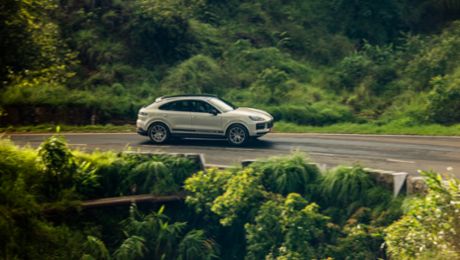
Expect a luxury EV in India to be worth roughly 55 to 75 percent of its launch price after two to three years, with most falling toward the lower half of that range. The clearest signal comes from a carmaker itself: in August 2026, Porsche India began offering an assured buyback of up to 70 percent after three years on the petrol Cayenne, but only up to 55 percent on the electric Macan and Taycan. Asking prices on Motozite’s pre-owned listings tell a similar story, with a two- to three-year-old Mercedes EQE SUV at about 57 percent of its launch price. Luxury EVs lose value faster than equivalent petrol cars, which is bad news for the first owner and good news for the second.
The number that matters: Porsche’s 70 versus 55
Resale forecasts are usually guesswork. A buyback guarantee isn’t, because someone has put money behind it.
Porsche India’s Assured Buy-Back Program, announced in August 2026 and run through a partner company, sets a future value at the time of purchase and covers the gap if the car sells for less after up to 36 months. Autocar India and Autocar Professional both report the split: up to 70 percent of the original value for the Cayenne, and up to 55 percent for the Macan Electric and Taycan.
That 15-point gap is the market’s verdict on electric depreciation, priced by people whose job it is to get it right. On a Rs 1.65 crore Macan Electric Turbo, 55 percent is about Rs 91 lakh after three years. Other brands’ schemes point the same way, though the terms differ: Mercedes-Benz Financial Services offered EQA buyers an assured buyback of 67 percent after four years when the car launched in 2024, and JLR India introduced a buyback of up to 55 percent on selected Range Rover, Defender and Discovery models in July 2026. These schemes come with conditions, such as mileage limits and finance tie-ins, so read the fine print before you count on the headline figure.
What used luxury EVs are actually listed for
On 30 October 2026, Motozite’s pre-owned electric listings showed twelve luxury EVs. Here is how the asking prices compare with each model’s launch price:
| Car (registration year as listed) | Km | Asking price | Launch price (ex-showroom) | Asking as % of launch |
| Mercedes-Benz EQE 500 4Matic SUV (2023) | 26,106 | Rs 79.75 lakh | Rs 1.39 crore (Sept 2023) | 57% |
| Volvo XC40 Recharge E80 Ultimate (2023) | 38,236 | Rs 38 lakh | Rs 55.90 lakh (July 2022) | 68% |
| Volvo XC40 Recharge E80 Ultimate (2023) | 25,216 | Rs 42 lakh | Rs 55.90 lakh (July 2022) | 75% |
| BMW iX xDrive40 (2024) | 25,000 | Rs 77.90 lakh | Rs 1.16 crore (Dec 2021) | 67% |
| Porsche Macan Electric Turbo (2024) | 11,800 | Rs 1.28 crore | Rs 1.65 crore (Jan 2024) | 78% |
How to read this: asking prices exclude other charges and are what sellers want, not what cars finally sell for. Launch prices are the first price announced in India, and many cars cost more new once options and later price rises are added (the XC40 Recharge E80 was Rs 57.90 lakh by March 2024, for instance). So real retention is usually lower than this table suggests. Twelve listings is also a small sample. Treat these as a snapshot, not an index.
Even so, the pattern is clear. The EQE SUV, a big, expensive EV from a brand whose petrol cars hold value well, is asking 43 percent below its launch price at two to three years old. The Macan Electric looks strong, but it’s younger, and nobody has yet sold one at three years under the new buyback floor.
Why luxury EVs depreciate faster in India
The battery is the unknown. A used-car buyer can judge an engine by its service history and how it drives. A high-voltage battery is harder to read, and it’s the most expensive part of the car. Autocar India said in July 2026 that battery health is the biggest factor in a used EV’s resale value. Buyers discount for that uncertainty.
The warranty clock keeps ticking. Most luxury EV battery warranties in India run for 8 years (or 1,60,000km on many models) from the first sale, not from when the next owner buys. A three-year-old car has five years of battery cover left, and the buyer prices that in. Our guide to checking battery health and transferring the warranty goes through each brand’s terms.
New models get better, and sometimes cheaper. EV technology moves faster than engines do. When BMW launched the locally built i7 eDrive50 in September 2026 from Rs 1.95 crore, it claimed 125km more WLTP range than the outgoing car. That’s the same starting price at which the i7 arrived in India in 2023, but with more range. Every improvement like that makes the older car look dated overnight.
The tax gap with petrol cars has narrowed. EVs still carry 5 percent GST. But since 22 September 2025, large petrol and diesel cars pay a flat 40 percent GST instead of 28 percent plus cess, which used to take the total to as much as 50 percent. New luxury petrol cars got cheaper, EVs didn’t, and a used EV now competes with a new petrol car that has moved closer on price. This is our reading of the market, not a measured effect, but it’s hard to see it helping EV resale.
Some models are gone. Audi ended production of the Q8 e-tron in February 2025 and Jaguar’s I-Pace was scheduled to end in December 2024. Discontinued EVs carry an extra question mark over parts and software support, and buyers price that in too.
Which luxury EVs hold value better
From the evidence above, a few things help a luxury EV hold its value in India:
- A brand with a strong used-car following, where the petrol versions are already sought after. Porsche and Volvo show up well in the snapshot above.
- A model that’s still on sale, ideally one that hasn’t just been replaced by a much-improved version.
- Plenty of battery warranty left, with the 8-year clock started recently.
- A full authorised service history, including battery checks and software updates.
- Moderate mileage for its age. In our experience, EV buyers worry less about kilometres than about battery health, but very high use still raises questions about the battery.
What hurts: a discontinued model, a big model-year update that arrived just after you bought, accident or flood history, and a car whose battery report the seller can’t or won’t produce.
Our view: who wins, who loses
If you’re buying new and plan to sell in three years, a luxury EV is an expensive way to own a car. Either take the brand’s assured buyback if one is offered and its terms suit you, or plan to keep the car for six years or more, when the depreciation curve has flattened, and you’ve had the low running costs for longer.
If you’re buying used, this is the best part of the market. A two- to three-year-old luxury EV with five or more years of battery warranty left and a clean dealer battery report is a lot of car for the money. The first owner has absorbed the steepest drop.
If you’re selling, get ahead of the buyer’s biggest worry. A dealer battery report printed against the VIN, a complete service history, and a clear statement of the remaining battery warranty will do more for your price than a detailing job.
You can compare asking prices for pre-owned electric luxury cars and demo EVs listed by sellers across India on Motozite, or check the on-road price calculator to see what the same car costs new today.
FAQs
How much value does a luxury EV lose in 3 years in India?
Expect a luxury EV to be worth roughly 55 to 75 percent of its launch price after two to three years. Porsche India’s buyback guarantees up to 55 percent after three years on the Macan Electric and Taycan, against up to 70 percent on the petrol Cayenne. On 30 October 2026, a 2023 Mercedes EQE SUV listed on Motozite was asking about 57 percent of its launch price.
Do electric cars have poor resale value in India?
Luxury EVs generally depreciate faster than comparable petrol cars. Buyers discount for battery uncertainty, the shrinking battery warranty and fast-improving new models. That makes them expensive to own for three years and good value to buy used.
Which luxury EV has the best resale value in India?
There isn’t enough sales data to name one reliably. In Motozite’s listings snapshot, the Porsche Macan Electric and Volvo XC40 Recharge were asking the highest share of their launch prices, but the Macan cars are younger. Models still on sale, from brands with strong used-car demand and with plenty of battery warranty left, hold value best.
Is it better to buy a used luxury EV than a new one?
For most buyers who don’t need the latest model, yes. The first owner takes the steepest depreciation, and a two- to three-year-old car still has about five years of an 8-year battery warranty left. Get a dealer battery report and confirm the warranty transfers before you buy.
Does a luxury EV assured buyback make sense?
It can, if you’re sure you’ll sell within the programme’s term. Porsche India’s scheme covers up to 36 months, and Mercedes offered 67 percent after four years on the EQA at launch. Check the mileage limits, condition rules and any finance tie-in, because the guarantee only holds if you meet them.
Does battery health affect EV resale value?
Yes, more than anything else. Autocar India says battery health is the biggest factor in a used EV’s resale value. A printed dealer battery report and a full service history are the best ways to protect your selling price.
