
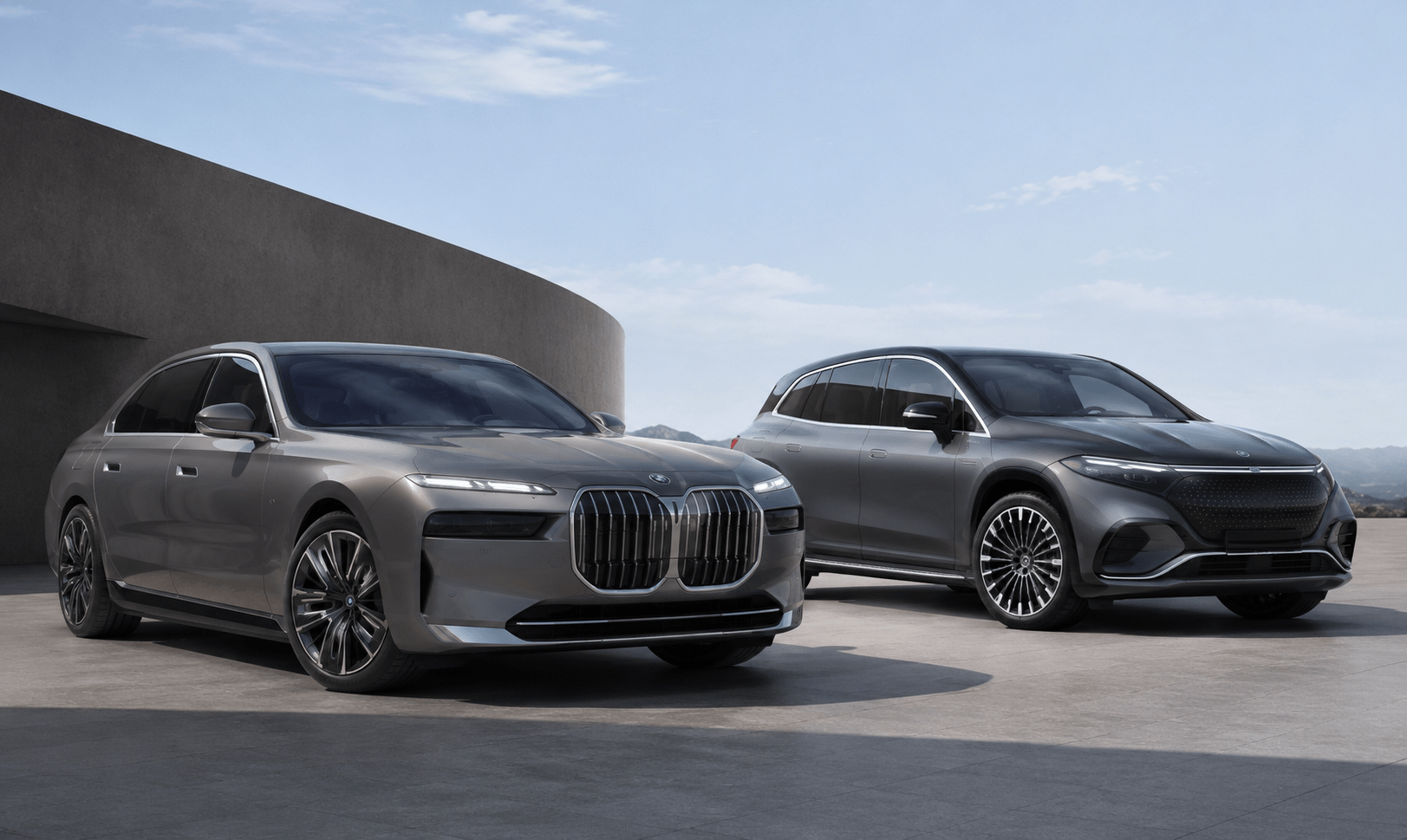
The landscape of Indian luxury asset accumulation has shifted. While global premium automotive markets navigate a period of macroeconomic stabilization and changing demand curves, India’s luxury car segment has locked into a historic acceleration phase. The first half of 2026 has witnessed unprecedented capital allocation toward high-tier mobility, defying inflation concerns and high import duties.
For the country’s High-Net-Worth Individuals (HNWIs), corporate leaders, and young founders, a luxury garage is no longer merely a marker of baseline success—it is a sophisticated play in lifestyle optimization, corporate tax positioning, and technological adoption.
According to official half-yearly performance data released by the country’s leading premium manufacturers, the battle for dominance between Stuttgart and Munich has reached a boiling point. Driven by a younger demographic pivot and a distinct appetite for top-tier customization, the market has moved far beyond entry-level premium sedans.
Here is an analytical breakdown of how Mercedes-Benz and BMW achieved record-breaking volumes in H1 2026, and what these shifts mean for your next vehicle acquisition.
The H1 2026 Scorecard: Mercedes-Benz vs. BMW India
The performance numbers for the first six months of 2026 reveal a market operating at peak capacity. Rather than a zero-sum game, both German legacy brands have carved out distinct paths to volume growth, capitalising on different pillars of consumer demand.
Mercedes-Benz India: Protecting the Crown with Top-End Luxury
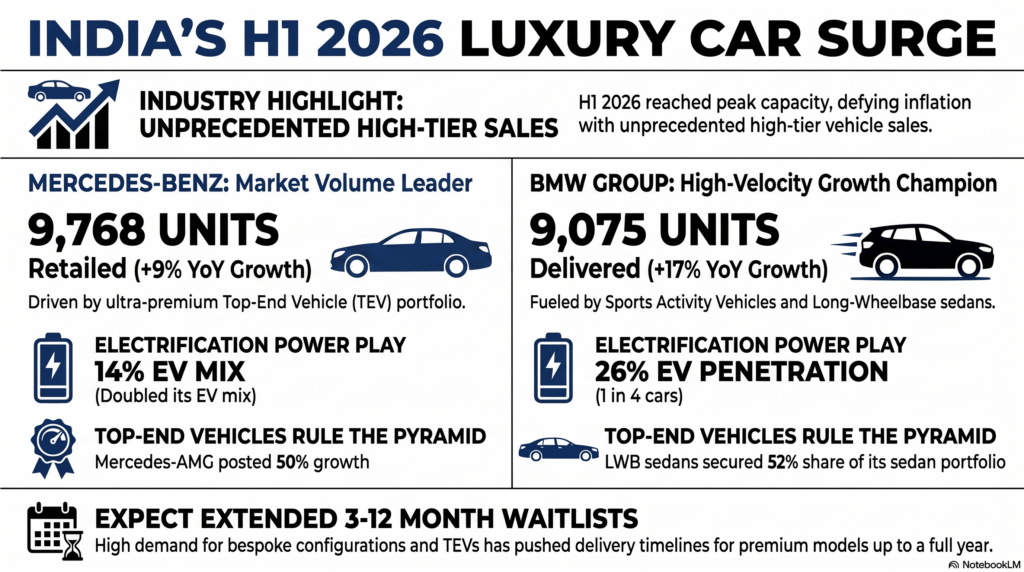
Mercedes-Benz India sustained its market leadership position by focusing heavily on margin-rich, ultra-premium allocations. The brand reported a record-breaking 9,768 units retailed during H1 2026. This represents a robust 9% Year-on-Year (YoY) growth compared to the same period in 2025.
The core driver for Mercedes-Benz was not mass premium volume, but rather their Top-End Vehicle (TEV) portfolio, indicating that the Indian ultra-HNWI cohort is spending higher amounts per vehicle than ever before.
BMW Group India: High-Velocity Market Capture
BMW Group India executed an aggressive, high-momentum product offensive that closed the volume gap significantly. Delivering 9,075 units to customers across the country, the Munich-based manufacturer registered a spectacular 17% YoY growth.
BMW’s strategy leveraged immediate product availability, an expansive Sports Activity Vehicle (SAV) portfolio, and an absolute dominance in the luxury electric vehicle vertical to secure double-digit growth velocity.
Performance Data Matrix: H1 2026 At a Glance
| Performance Metric | Mercedes-Benz India | BMW Group India |
| H1 2026 Retail Volumes | 9,768 Units | 9,075 Units |
| YoY Volume Growth | 9% | 17% |
| Core Portfolio Anchor | Top-End Vehicles (TEVs) | Sports Activity Vehicles (SAVs) |
| Key Growth Driver | AMG & Maybach Sub-brands | Long-Wheelbase Sedans & Luxury EVs |
| EV Market Share Mix | 14% (Q2 2026) | 26% (H1 2026) |
Decoding the Anatomy of the H1 Boom
To truly understand why luxury car sales India 2026 are outperforming traditional market cycles, one must analyze the specific product configurations and vehicle variations currently capturing consumer capital. The traditional three-box sedan and entry-level luxury crossovers are no longer the primary growth engines.
The Ascendancy of Top-End Vehicles (TEVs)
The most striking revelation from the H1 2026 data is the shift toward the absolute peak of the luxury pyramid. In the Mercedes-Benz ecosystem, Top-End Vehicles—which include the Mercedes-Maybach range, the high-performance AMG lineup, the iconic S-Class, and the ultra-luxury GLS SUV—commanded a historic 28% share of the brand’s total sales volume.
The high-performance AMG division alone posted a remarkable 50% growth rate in H1 2026. Affluent Indian buyers are actively bypassing mid-tier trims in favor of bespoke paint options, upgraded performance dynamics, and personalized interior appointments. The demand for models like the AMG G 63 and the Maybach GLS 600 underscores a desire for uncompromised road presence.
The Chauffeur’s Priority: Long-Wheelbase Dominance
While performance driving is rising among self-driving entrepreneurs, the rear-seat experience remains paramount for India’s corporate executive class. BMW capitalized on this preference by localizing and prioritizing Long-Wheelbase (LWB) platforms.
During the first half of 2026, BMW’s LWB sedans—anchored by the highly successful 3 Series Gran Limousine and the flagship 7 Series—accounted for a staggering 52% share of the brand’s total sedan portfolio, translating to 4,428 units. By providing segment-first legroom and executive seating configurations at highly competitive price points, the manufacturer captured the corporate commuter market effectively.
Dominating the Tarmac: Premium SUVs
Mixed urban infrastructure and the desire for high seating positions continue to make high-end SUVs the default choice for luxury buyers. The best-selling luxury cars in India lists are increasingly dominated by high-ground-clearance architectures.
BMW’s SAV portfolio—led by the locally assembled X1, the mid-sized X5, and the imposing X7—registered a 35% volume increase, delivering 5,926 units. Simultaneously, Mercedes-Benz noted that waitlists for the GLC and GLE SUVs remain consistently high, with utility vehicles making up more than half of their standard order books.
The Electrification Pivot: Green is the New Premium
A defining trend in the luxury EV market in India is that the transition to electric mobility is occurring at a significantly faster rate within the luxury tiers than in mass-market segments. For HNWIs and corporate entities, the transition to premium battery electric vehicles (BEVs) offers clear fiscal advantages alongside technological superiority.
BMW’s Electric Footprint
BMW Group India secured a commanding first-mover advantage in the premium electric vehicle space. In H1 2026, one out of every four BMWs sold was a pure electric vehicle, translating to an astonishing 26% penetration rate (2,359 units).
Models like the BMW i7 flagship sedan and the highly practical iX1 crossover have resonated deeply with buyers seeking low running costs, seamless torque delivery, and access to priority green parking infrastructure in metropolitan hubs.
The Mercedes-Benz EV Pipeline
Mercedes-Benz has taken a targeted approach to the luxury EV space, steadily ramping up its localized assembly operations. By Q2 2026, the brand successfully doubled its electric vehicle sales mix to 14% of total volume.
The momentum was driven by the introduction of the highly aerodynamic CLA BEV sedan and the rollout of the locally assembled EQS SUV. Corporate buyers are increasingly using these vehicles to leverage the highly favorable 5% flat GST rate on electric vehicles, contrasted against the much higher tax brackets levied on internal combustion engines.
As we move deeper into the second half of 2026, the primary challenge facing the Indian luxury automotive sector is not generating demand, but managing order backlogs. Production capacities are being scaled up, yet allocation shortages for bespoke configurations remain a standard reality.
- The Rise of Tier-2 Wealth Hubs: The geographic concentration of luxury buyers is shifting. While Mumbai, Delhi-NCR, and Bengaluru remain the primary volume drivers, Mercedes-Benz and BMW are aggressively expanding their physical footprints into rapidly emerging wealth centers. Cities like Varanasi, Surat, Ludhiana, and Kochi are registering double-digit luxury vehicle adoption rates, driven by industrial expansion and agro-wealth.
- Fiscal Planning Strategy: For corporate buyers and business owners looking to optimize their balance sheets before fiscal year-end, placing orders early in Q3 is vital to ensure vehicle delivery and vehicle registration occur within the desired tax window, allowing for maximum depreciation write-offs.
The H1 2026 sales figures confirm that the luxury automotive space in India has entered a new era of maturity. Whether your next acquisition is a track-focused AMG, a chauffeured long-wheelbase limousine, or a silent, zero-emissions luxury EV, the market is offering highly sophisticated products tailored perfectly to Indian roads and fiscal realities.
For more insights into luxury car trends, reviews, and industry updates, explore the latest stories on Motozite.
