
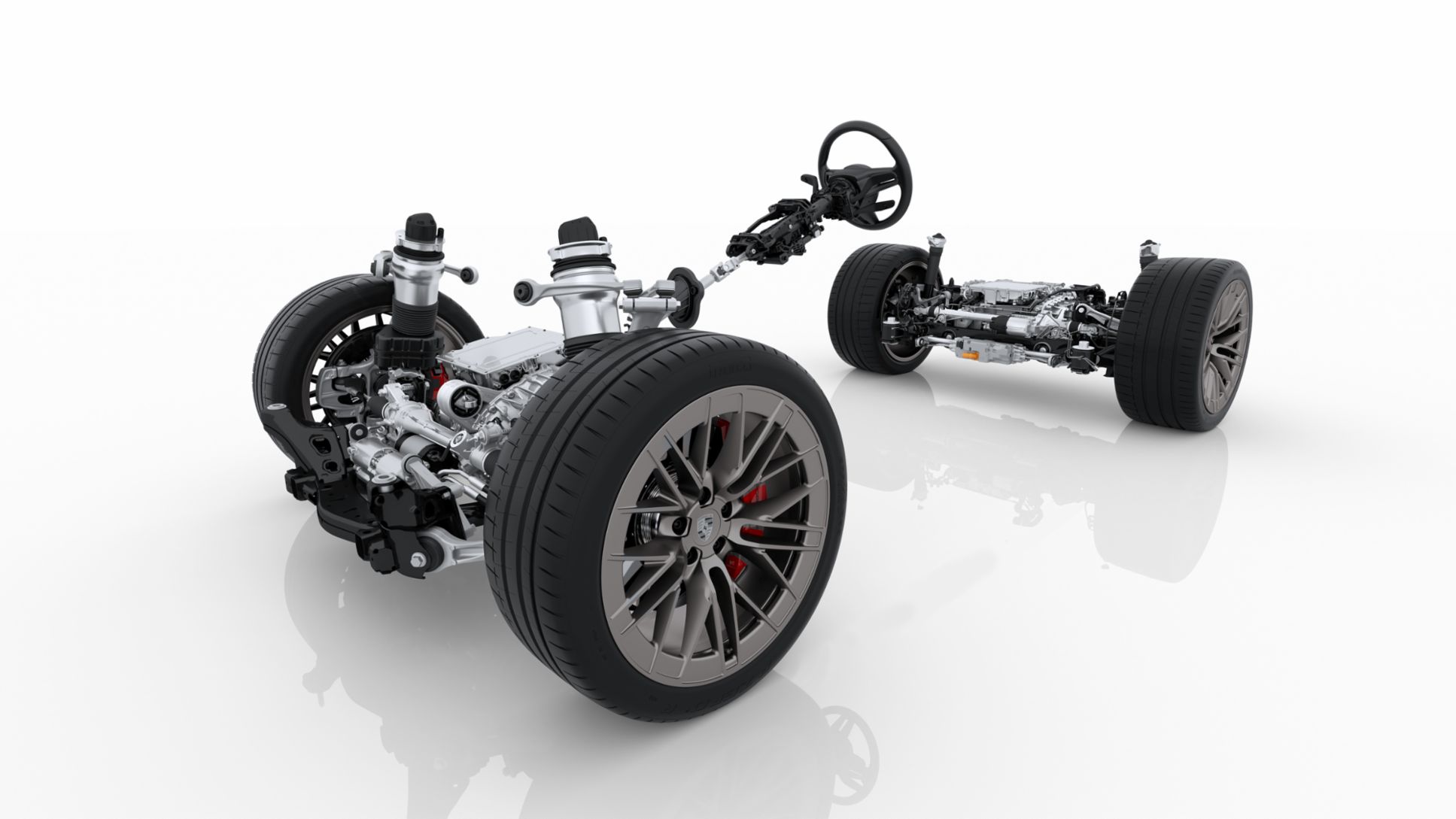
Rear-wheel steering turns the back wheels by a few degrees, usually under 10, so a long luxury car behaves like a shorter one at parking speeds and a longer, steadier one on the highway. At low speed the rear wheels turn the opposite way to the fronts, which shrinks the turning circle; above a set speed they turn the same way, which calms lane changes. In India it is a Rs 1 crore-plus feature: it comes standard on the Range Rover and the Lexus RX 500h, is fitted to flagships such as the Rolls-Royce Cullinan and Lamborghini Urus, and is optional or variant-dependent on cars such as the Mercedes S-Class, Porsche Cayenne Electric and BMW i7. On a car longer than about five metres that will live in Indian cities, we think it is worth having.
How rear-wheel steering works
The hardware is simple to describe. An electric actuator on the rear axle pushes the rear wheels a few degrees left or right, and software decides how far and which way based on your speed and how much you have turned the steering wheel. Makers call it different things: rear-axle steering (Mercedes and Porsche), All-Wheel Steering (Land Rover), Integral Active Steering (BMW), Dynamic Rear Steering (Lexus), all-wheel steering (Audi) or four-wheel steering (Rolls-Royce). They all do the same basic job in two modes.
Below the switch-over speed: opposite direction. The rear wheels turn against the front wheels. The car pivots around a point closer to its middle, so it turns as if its wheelbase were shorter. This is what you feel in a mall basement or a three-point turn.
Above the switch-over speed: same direction. The rear wheels follow the fronts by a smaller angle. The car moves sideways a little more as a whole rather than rotating, so a quick lane change on an expressway feels calmer. Porsche says the high-speed mode helps stability in exactly that situation.
The interesting part is where each brand sets the switch-over point. It varies a lot:
| Car | Max rear-wheel angle | Switches to same-direction steering at | Source |
| Mercedes-Benz S-Class | 4.5 or 10 degrees (two versions) | About 60km/h (37mph) | Mercedes-Benz USA press kit |
| Range Rover | Up to 7.3 degrees | 50km/h | Land Rover press kit |
| Porsche Cayenne Electric | Up to 5 degrees | 100km/h | Porsche newsroom |
| Porsche 911 GT3 and Turbo (991, 2013) | Up to 1.5 degrees | 50km/h | Autocar India |
| Lexus RX 500h | Up to 4 degrees | Not stated | Lexus Europe newsroom |
| Mercedes-Benz EQS | 10 degrees | Not stated | Autocar India review |
A small angle sounds like nothing. It isn’t. On the S-Class, Mercedes says the 10-degree system cuts the turning circle of the rear-wheel-drive car from 12.5 metres to 10.8 metres, and even the milder 4.5-degree version takes it to 11.7 metres. That is the difference between making a U-turn on a Gurugram service lane in one go and reversing once in front of traffic.
Rear-wheel steering by the numbers: turning circles
| Car | Without rear-wheel steering | With rear-wheel steering | Source |
| Mercedes S-Class (rear-wheel drive) | 12.5m | 11.7m (4.5°) / 10.8m (10°) | Mercedes-Benz USA |
| Mercedes S-Class (long wheelbase, 4MATIC) | 12.8m | 11.9m (4.5°) / 10.9m (10°) | Mercedes-Benz USA |
| Porsche Cayenne Electric | 12.7m | 11.6m | Porsche newsroom |
| Range Rover (standard wheelbase) | Not offered | 10.95m | Land Rover press kit |
| Range Rover (long wheelbase) | Not offered | 11.54m | Land Rover press kit |
Two India-specific points come out of this table. First, the Range Rover variants Autocar India lists for India are all long-wheelbase, so the figure that applies here is 11.54 metres, not the headline “under 11 metres” Land Rover quotes for the shorter car. Second, Mercedes fits a quicker front steering ratio, about 15 percent more direct, on S-Class cars with rear-axle steering, so you also turn the wheel less. Porsche makes a similar point about the Cayenne Electric, saying the steering input needed falls by 24 percent.
Which luxury cars in India have rear-wheel steering?
This is the list we could confirm from OEM pages and Indian editorial sources as of October 2026. Check the exact variant before you buy, because fitment changes between model years and some of these are options.
| Car | In India | What we found |
| Range Rover | Standard | Land Rover says every Range Rover of this generation has All-Wheel Steering, and Autocar India’s specification page lists four-wheel steer. |
| Range Rover Sport | Listed on India specs | Autocar India’s specification page lists four-wheel steering. Globally, Land Rover has sold it as part of the optional Stormer Handling Pack, so confirm it on the variant you are looking at. |
| Mercedes-Benz S-Class (S 450e) | Fitted | Autocar India’s S-Class page lists rear-wheel steering alongside the air suspension, with a 5.85m turning radius. The maximum angle for the India car isn’t stated. |
| Mercedes-Benz EQS 580 | Was limited | At launch in 2022, Mercedes India offered the 10-degree system only to the first 500 buyers, according to Autocar India and Autocar Professional. Check the build list on any EQS, new or used. |
| BMW i7 | Available | BMW India’s 2023 launch release says Integral Active Steering is available on the i7. It does not mention it for the 740i petrol. |
| Porsche Cayenne Electric | Optional | Autocar India and Porsche both list rear-axle steering as an option. |
| Lexus RX 500h F-Sport+ | Standard | Rear-wheel steering is one of the things the extra Rs 19.5 lakh over the RX 350h buys you. The RX 350h does not get it. |
| Audi RS Q8 Performance | Fitted | Audi India’s February 2025 launch release lists all-wheel steering among its features. |
| Lamborghini Urus | Fitted | Autocar India’s road test credits the rear-wheel steering, active anti-roll bars and torque vectoring for making the 2.1-tonne SUV turn in like a hot hatchback. |
| Lotus Eletre R | Fitted | Autocar India’s December 2023 review of the Eletre R lists rear-wheel steering and says it helps the car feel nimble in traffic. |
| Rolls-Royce Cullinan | Fitted | The Cullinan launched in 2018 as the first Rolls-Royce with both four-wheel drive and four-wheel steering. |
Every car on this list starts above Rs 1 crore ex-showroom. The most affordable way into the technology in India today is the Lexus RX 500h, launched at Rs 1.09 crore ex-showroom in December 2025. The Porsche Cayenne Electric starts at Rs 1.77 crore, though there you pay extra for the option.
Where rear-wheel steering helps on Indian roads
Basements and parking ramps. Indian mall and office basements are built around hatchbacks and compact sedans. A 5.3-metre limousine or SUV that needs one shuffle less to get past a pillar is a car you are less likely to scrape. This is where rear-wheel steering pays for itself most often.
U-turns and narrow lanes. Old-city lanes in Delhi, Mumbai’s Bandra or Bengaluru’s Malleswaram reward a tight turning circle. Shaving a metre off it matters more here than in Europe, where the cars were designed.
Ghat roads. On a hairpin, the car needs less steering lock to get round, so you are not shuffling your hands through a tight corner. Autocar India’s Urus test is a good example of how much more agile a big, heavy car can feel with the system working.
Expressways. At highway speeds, the same-direction mode makes quick lane changes feel more settled. Useful on the Mumbai-Pune or Delhi-Mumbai expressways, but honestly a smaller benefit than the low-speed one for most Indian owners.
Off-road. Land Rover says the system helps steer the Range Rover out of ruts and keeps it tracking straight on soft ground, which is a real bonus on a muddy farmhouse road.
The downsides nobody puts in the brochure
It is one more component to go wrong. An actuator, wiring, and a control unit sit on the rear axle, next to the air suspension on most of these cars. If you are buying used, add it to your inspection list along with the air springs. Our guide to air suspension problems in luxury cars covers the warning signs for the system it usually sits beside.
It can limit your wheel choice. Mercedes notes that the 10-degree S-Class system restricts tyres to 255/40 R20 so the wheels have room to turn. Owners who want bigger aftermarket wheels should check clearance first.
The tail moves differently. With the rear wheels steering the opposite way, the back of the car swings outward a little more as you turn tightly. It is easy to adapt to, but in your first week, watch the rear corners near basement pillars and kerbs.
You often pay extra. On cars where it is an option, it adds to a price that is already high. Optional also means a used car may or may not have it, and sellers do not always know.
Is rear-wheel steering worth it? Our view
Worth paying for on any luxury car longer than about five metres that will spend most of its life in an Indian city, and especially if it is owner-driven. The S-Class, i7, EQS and Cayenne fall into this group. The gain in daily usability is large and you feel it every time you park.
Nice to have, not essential on mid-size luxury SUVs that already turn tightly, where the benefit is smaller.
Not a reason to choose one car over another on its own. If the car you prefer doesn’t offer it, a good parking camera system and a bit of practice will cover most of the gap.
Buying used? On models where it was optional, confirm it is actually fitted. Ask for the original specification sheet or have a dealer read the build data from the VIN, then check on the test drive that the turning circle feels tight at full lock and no chassis warnings appear. Our luxury car test drive checklist is a good companion for that drive. You can browse pre-owned luxury SUVs and pre-owned luxury sedans listed on Motozite, and for the S-Class specifically, our S 450e plug-in hybrid guide covers the rest of the buying decision.
A short history: from the Honda Prelude to the S-Class
Rear-wheel steering is not new. Honda’s 1987 Prelude had a purely mechanical system with no electronics at all: at small steering angles the rear wheels turned with the fronts, and at large angles they turned against them. Honda calls it the world’s first steering-angle-sensing four-wheel steering.
The idea faded in the 1990s and came back in luxury cars once electric actuators and software made it smoother. BMW offered Integral Active Steering on the 2009 7 Series, which Autocar India’s Shapur Kotwal remembers being surprised by and notes that few buyers ordered. Porsche fitted it to the 911 GT3 and Turbo in 2013. Since then it has spread through the big luxury cars, and on several flagships it is now standard rather than an option.
FAQ
What is rear-wheel steering in a car?
Rear-wheel steering is a system that turns the rear wheels by a few degrees as well as the front wheels. At low speed, the rear wheels turn opposite to the front ones to tighten the turning circle, and at higher speed they turn the same way to make lane changes more stable. Makers also call it rear-axle steering, all-wheel steering or four-wheel steering.
Which cars in India have rear-wheel steering?
As of October 2026, it is standard on the Range Rover and the Lexus RX 500h, and is fitted or listed on the Rolls-Royce Cullinan, Mercedes S-Class, Range Rover Sport, Audi RS Q8 Performance, Lamborghini Urus, and Lotus Eletre R. It is optional on the Porsche Cayenne Electric and available on the BMW i7. Fitment can change by variant and year, so confirm it on the exact car.
How much does rear-wheel steering reduce the turning circle?
It depends on the car and the steering angle. Mercedes says the S-Class’s turning circle falls from 12.5m to 11.7m with its 4.5-degree system and to 10.8m with the 10-degree system. Porsche says the Cayenne Electric’s falls from 12.7m to 11.6m.
At what speed does rear-wheel steering switch direction?
Each brand sets its own point. The Range Rover switches to same-direction steering above 50km/h, the Mercedes S-Class above about 60km/h (37mph), and the Porsche Cayenne Electric above 100km/h. Below those speeds, the rear wheels turn against the front wheels.
Is rear-wheel steering worth it in India?
For a large luxury car used mostly in Indian cities, yes. Tight basements, U-turns and narrow lanes are where the smaller turning circle helps most. It adds cost and one more component to maintain, so on a mid-size SUV that already turns tightly, it is a nice-to-have rather than a must.
What is the cheapest car in India with rear-wheel steering?
Of the cars we could confirm, the Lexus RX 500h F-Sport+ is the most affordable, launched at Rs 1.09 crore ex-showroom in December 2025. Every car we found with rear-wheel steering in India starts above Rs 1 crore.
