
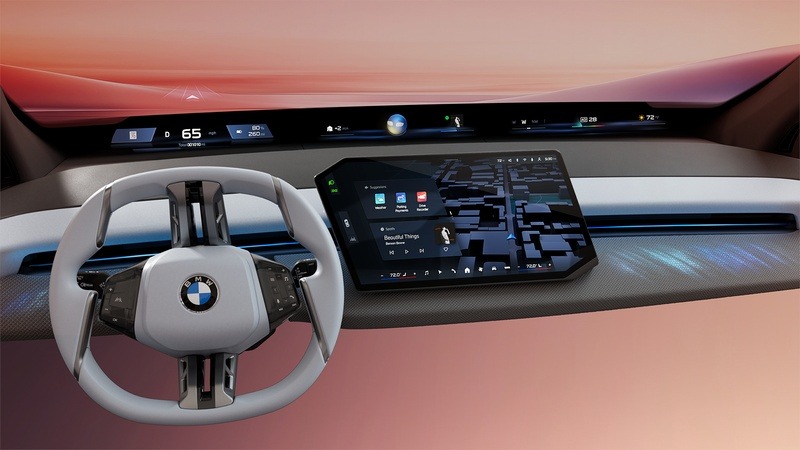
A 3D instrument cluster is a digital driver display that adds real depth to the image, so warnings, gauges and the driver-assistance view appear to sit at different distances from your eyes. The best-known version in India is Mercedes-Benz’s 3D driver display, which uses cameras to track your eyes and shows each eye a slightly different image, with no glasses needed. Mercedes-Benz India lists it on the Mercedes-Maybach S 580e. It looks remarkable, but it is the least important thing a modern cluster does. What matters more is how clearly it shows speed, warnings and navigation, and how well you can set it up. And at the very top of the market, the cluster itself is starting to disappear: the 2026 BMW 7 Series sold in India no longer has one.
From dials to digital: a short history
For most of motoring history, the instrument cluster was a set of needles behind glass. The switch to screens in premium cars took off with the Audi virtual cockpit, which debuted on the 2014 Audi TT as a 12.3-inch screen with 1,440 x 540 pixels that replaced the conventional dials completely. Audi said it shone at 800 candelas, twice the industry norm at the time.
A decade on, a 12.3-inch digital driver display is the default in Indian luxury cars. The Mercedes S-Class and E-Class both use one, the BMW X3 pairs a 12.3-inch information display with a 14.9-inch touchscreen in one curved panel, and Audi’s new Q3 puts an 11.9-inch driver display and a 12.8-inch touchscreen under a single curved glass. The question now is not whether the cluster is digital. It’s what kind of digital.
Three kinds of “3D” cluster, and why the difference matters
1. True 3D (autostereoscopic). This is Mercedes’ approach. The 12.3-inch driver display is an LCD with a resolution of 2,400 x 900 pixels in 2D, according to Display Daily, and it can switch to a 3D mode viewable without glasses. Mercedes explains the trick in its S-Class technical material: a “barrier mask” sits a few millimetres in front of the LCD and is adjusted so precisely to your head position that your left and right eyes see different pixels. That difference is what your brain reads as depth. A stereo camera built into the display tracks where your eyes are, and Mercedes says its low-latency software lets you move your head freely while the image keeps adjusting.
2. Layered displays. Peugeot’s 3D i-Cockpit, developed with the supplier Visteon for the Peugeot 208, uses two screens stacked at different depths, so important information appears to float closer to the driver as a “hologram”. Visteon called it the first real 3D cluster in volume production. Peugeot doesn’t sell cars in India, but the idea is worth knowing because it creates depth without any eye-tracking.
3. 3D-style graphics on a flat screen. This is what most digital clusters do. A rendered car sitting in its lane, with nearby vehicles and lane lines in perspective, looks three-dimensional, but the screen itself is flat and both eyes see the same image. It is a design choice, not a display technology, and it works on any digital cluster.
| True 3D (Mercedes) | Layered (Peugeot 3D i-Cockpit) | 3D-style graphics | |
| How depth is created | Barrier mask in front of an LCD, plus eye-tracking cameras | Two screens at different depths | Perspective drawing on one flat screen |
| Needs a driver camera? | Yes | No | No |
| Can be switched off? | Yes, to a 2D view | Not applicable | Not applicable |
| Seen in India | Mercedes-Maybach S 580e; Mercedes S-Class and E-Class family (confirm by variant) | Not sold in India | Most luxury cars |
What a 3D driver display actually does for you
It separates what matters from what doesn’t. Depth gives designers one more way to rank information. A warning can sit visually in front of the speed reading, and the driver-assistance view can show the car ahead as genuinely further away than your own. Mercedes has tied the 3D effect to the same spatial theme as its augmented reality head-up display, which we explain in our companion guide to AR vs conventional head-up displays.
It is configurable. Mercedes offers several display styles in the S-Class cluster, and the 3D effect can be turned down to 2D or a flatter view. That flexibility is a bigger benefit than the depth itself.
It improves through updates. Mercedes says more than 50 electronic components in the current S-Class can be updated over the air, explicitly including the driver display. A cluster that gets new layouts after purchase is worth more than one frozen on the day you bought the car.
It impresses reviewers. Autocar India’s first drive of the long-wheelbase E-Class said the 3D effect “works like a charm”. That is a fair summary of the first five minutes with it.
The limitations nobody mentions in the showroom
It depends on the driver camera. Mercedes’ owner’s manual states the 3D view needs the driver camera to record you. If the camera is switched off, not working, or you are outside its detection range, the display drops back to 2D. If you are uneasy about a camera watching your face, know that the 3D feature cannot work without one.
It has a sweet spot. Display Daily notes that autostereoscopic screens usually have an ideal viewing position. Mercedes’ eye-tracking widens that zone a lot, but a very upright or very reclined driving position, or a quick glance from off-centre, can still briefly soften the image.
It can’t be photographed. Because each eye sees a different picture, a camera captures a blurred mix. If you like sharing photos of your car’s cabin, switch the 3D mode off first.
Heat can switch it off. This is the India-specific one. The same Mercedes manual says the 3D display may be unavailable when operating conditions aren’t met, and gives outside temperature that is too low or too high as an example. Mercedes doesn’t publish the threshold, so if you live in Rajasthan, Delhi or Nagpur, ask the dealer how the system behaves after the car has been parked in summer sun.
Long-drive comfort is an open question. Car and Driver, in its first look at the S-Class, said it was hard to tell whether the 3D cluster would cause eye fatigue on long drives. We are not aware of published research either way. If you drive long distances yourself, try the 3D mode for more than a few minutes on the test drive and switch it off if it tires you.
BMW’s answer: no cluster at all
While Mercedes added depth to the cluster, BMW removed it. The 2026 7 Series and i7, launched in India on 11 September 2026 at Rs 1.95 crore to Rs 2.65 crore (ex-showroom), use BMW Panoramic iDrive. Autocar India reports that it replaces the conventional digital instrument cluster with a full-width projection at the base of the windscreen. BMW calls it Panoramic Vision.
The driver-relevant information, including speed, warnings and navigation, sits in the part of Panoramic Vision directly above the steering wheel, and you can choose up to six widgets for the rest of the strip. A separate BMW 3D Head-Up Display sits above it. Autocar India’s review of the new i7 described the result as sharp and brilliantly executed, sitting naturally in your field of vision without becoming distracting.
This matters beyond one model. BMW says Panoramic iDrive will reach its entire range, and the new iX3, its first Neue Klasse car, is due in India in 2027. Within a few years, a BMW buyer in India may not be choosing between cluster types at all.
Mercedes’ GLC Electric takes yet another route. Launched in India on 4 November 2026 at Rs 78.5 lakh (ex-showroom), it has a 39.1-inch MBUX Hyperscreen that combines the driver display, the central screen and the passenger display behind one piece of glass. Here, the cluster still exists, but as one section of a dashboard-wide screen.
Which premium cars in India have what
| Car (India) | Price (ex-showroom) | Driver display |
| Mercedes-Maybach S 580e | Rs 3.35 crore | 3D driver display, listed by Mercedes-Benz India |
| Mercedes-Benz S-Class (S 450e) | Rs 2.20 crore to Rs 2.38 crore | 12.3-inch digital driver display; confirm the 3D function on your variant |
| BMW 7 Series / i7 (2026) | Rs 1.95 crore to Rs 2.65 crore | No conventional cluster: Panoramic Vision plus BMW 3D Head-Up Display |
| Mercedes-Benz E-Class LWB | From Rs 81.50 lakh | 12.3-inch driver display in the Superscreen layout; 3D praised in Autocar India’s LWB drive, confirm for India spec |
| Mercedes-Benz GLC Electric | Rs 78.5 lakh | Driver display integrated into the 39.1-inch MBUX Hyperscreen |
| Audi Q3 (third generation) | Rs 51.99 lakh to Rs 55.99 lakh | 11.9-inch driver display under one curved panel with the touchscreen |
Feature lists change between model years and variants, so treat the 3D function as something to verify on the actual car, not something the badge guarantees.
Is a 3D instrument cluster worth paying for?
Our view: no, not on its own. On the cars that have it, the 3D driver display is part of a package, and it is a pleasant, well-engineered extra. But it doesn’t make a car safer or easier to drive in any way a well-designed 2D cluster can’t match. A clear layout, a readable font in bright sunlight, and a “calm” mode that shows only speed will matter more over five years of ownership than depth.
The bigger decision is the one BMW has forced. If you are choosing between a 7 Series and an S-Class, you are really choosing between two philosophies: a traditional driver display, with or without 3D, or information projected at the base of the windscreen. Drive both before deciding. Some drivers will love the clean dashboard of the BMW. Others will miss having the dials exactly where they have always been.
If you are chauffeur-driven, as many buyers of these cars in India are, none of this affects you directly. Spend the time in the back seat instead.
Buying pre-owned: check the cluster properly
Digital clusters are generally reliable, but a fault is a serious one. Mercedes’ manual warns that if the driver display fails, warnings about safety-relevant systems may not be shown, and advises parking safely and contacting a workshop. On a used car:
- Watch the start-up. Every warning light should illuminate and then go out. A cluster that shows nothing, flickers or reboots on the move needs a diagnosis before you buy.
- Test the 3D mode on Mercedes cars that have it, and check that the driver camera works, since 3D depends on it.
- Check the software version at an authorised workshop. Cluster layouts and fixes often arrive through updates, and an out-of-date car may also miss other improvements. Our guide to over-the-air updates in luxury cars explains what each brand has delivered.
- Look for dead pixels or pressure marks on the screen in bright light.
You can browse pre-owned luxury cars and new luxury cars on Motozite. For the screens that sit next to the cluster, see our comparison of BMW iDrive vs Mercedes MBUX vs Audi MMI.
FAQ: 3D instrument clusters
What is a 3D instrument cluster in a car?
It is a digital driver display that creates a real sense of depth, so some information appears closer to you than the rest. Mercedes-Benz’s version uses a barrier mask in front of the screen and eye-tracking cameras so each eye sees a slightly different image, without 3D glasses.
How does the Mercedes 3D driver display work?
A stereo camera in the display tracks the driver’s eye position. A barrier mask a few millimetres in front of the LCD is adjusted so the left and right eyes see different pixels, which the brain reads as depth. The image updates continuously as you move your head, and the effect can be switched to 2D.
Which cars in India have a 3D instrument cluster?
Mercedes-Benz India lists a 3D driver display on the Mercedes-Maybach S 580e, priced at Rs 3.35 crore. The function belongs to the same Mercedes driver-display family used in the S-Class and E-Class, but availability depends on the variant, so confirm it with the dealer.
Does the BMW 7 Series have an instrument cluster?
Not a conventional one. The 2026 BMW 7 Series and i7 sold in India replace the instrument cluster with BMW Panoramic Vision, a projection across the base of the windscreen, alongside a BMW 3D Head-Up Display. Speed, warnings and navigation appear in the section directly above the steering wheel.
Can you turn off the 3D effect in a Mercedes?
Yes. The 3D driver display can be switched to a 2D or flatter view. It also reverts to 2D automatically if the driver camera is off, can’t see you, or operating conditions such as outside temperature aren’t met.
Is a 3D instrument cluster worth it?
It is an impressive feature, but not one to choose a car for. A clear, configurable 2D layout gives almost all of the practical benefit. If you drive long distances yourself, test the 3D mode for a while to see whether it suits your eyes.
