
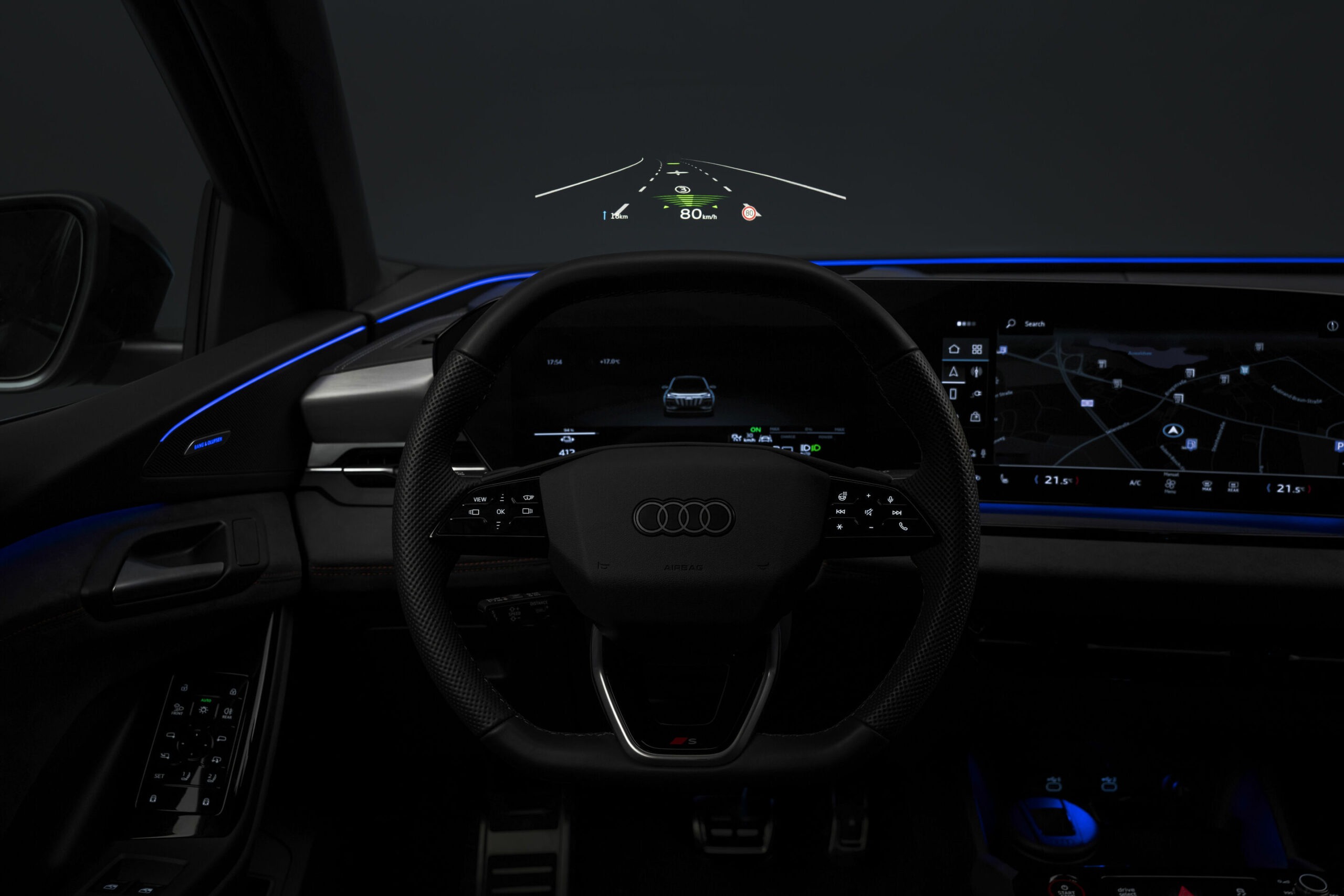
A conventional head-up display projects speed, speed limits and simple navigation arrows into a small window that appears to float a couple of metres ahead of the bonnet. An augmented reality (AR) head-up display projects a much larger image much further out, roughly 10 metres in the Mercedes S-Class, so its arrows and markers can sit on the actual road, the actual lane or the actual car ahead. That is the whole difference, and it decides how useful each one is. A conventional HUD saves you glancing down at the dials. An AR HUD tells you which lane, which exit and which car, in the place you are already looking. In India, you can now get both: the BMW X3 has a conventional HUD as standard, and the Mercedes S-Class, Mercedes-Maybach S 580e and the new BMW 7 Series offer the more advanced projections.
How a conventional head-up display works
A small projector buried in the dashboard shines an image onto the windscreen, which reflects it back towards the driver. Your eyes read that reflection as a “virtual image” hanging in space beyond the glass. In a conventional windscreen HUD, that image typically sits about 2 to 3 metres in front of the driver, with 2.5 metres being the common target, according to HUD patent literature filed with the US Patent and Trademark Office.
What you see is a compact block of information: speed, the speed limit from the traffic-sign camera, cruise control status, a turn arrow and sometimes the phone or media source. Nothing is tied to the road itself. The arrow tells you a right turn is coming, not which of the three gaps in the median is the right one.
The benefit is simple and real. BMW, the first European carmaker to put a HUD into series production (in the 5 Series, in 2004), points out that a car at 50kph covers around 14 metres while the driver looks down at the instruments. Mercedes-Benz uses a starker number for the highway: at 100kph, you cover about 28 metres every second. A HUD shortens those blind moments.
There is a cheaper variant worth knowing about. Some mass-market cars use a “combiner” HUD, where the image is reflected off a small flip-up glass panel on the dashboard rather than the windscreen. It does the same job, less elegantly. Every luxury car in this guide projects onto the windscreen.
How an augmented reality head-up display works
An AR HUD uses the same basic idea but pushes every number further. Mercedes-Benz’s specification for the S-Class AR HUD gives a field of view of 10 degrees horizontally and 5 degrees vertically, with the image placed about 10 metres ahead and a display area equivalent to a 77-inch screen. The image is generated by a Texas Instruments digital micromirror device with around 1.3 million tiny mirrors, the same type of technology used in cinema projectors.
Audi’s second-generation AR HUD in the Q6 e-tron goes further on paper. Audi says the AR field of view is equivalent to a diagonal of about 88 inches from the driver’s seat, that the image plane is tilted forward to strengthen the effect, and that symbols can appear to float up to 200 metres ahead of the car.
Placing graphics that far out is what makes “augmented” possible. Because the image sits at road distance, the car can lay animated arrows directly onto the lane you need, mark the vehicle that adaptive cruise control is following, and highlight a lane line you are drifting towards. Mercedes calls its navigation arrows “fishbones”, and in the S-Class they appear to lie on the road surface itself.
The cost is size and complexity. Continental, one of the largest HUD suppliers, has said a conventional windscreen HUD needs about 3 to 4 litres of space in the dashboard, while a mirror-based AR HUD needs around 30 litres, almost ten times as much. That is why AR HUDs usually appear in cars designed around them from the start, rather than as a bolt-on option.
AR HUD vs conventional HUD: side by side
| Conventional HUD | Augmented reality HUD | |
| Where the image appears | About 2 to 3 m ahead (2.5 m typical) | About 10 m ahead in the S-Class; Audi says symbols can appear up to 200 m out |
| Image size | Small window above the dashboard | Equivalent to a 77-inch (S-Class) or about 88-inch (Audi Q6 e-tron) screen |
| What it shows | Speed, speed limit, cruise status, simple turn arrows | All of that, plus arrows on the lane, markers on the car ahead, lane warnings |
| Hardware size | About 3 to 4 litres (Continental) | Around 30 litres for mirror-based units (Continental) |
| Typical availability in India | BMW X3 (standard), many luxury cars; now mass-market cars too | Mercedes S-Class, Maybach S 580e; “AR” units on Mahindra and Tata EVs and SUVs |
Don’t confuse an AR HUD with AR navigation on the screen
Mercedes-Benz has offered “augmented reality navigation” on its central screen for years. It uses the front camera to show a live video of the road as you approach a junction and overlays arrows and house numbers on that video. It is useful, and Autocar India’s review of the new E-Class praised how well the video-overlay prompts work.
But it is a different thing from an AR HUD. You still have to look down at the touchscreen, which is exactly what a HUD is meant to stop. Mercedes’ own owner’s manual also warns that the AR graphics can be incorrectly positioned in the camera image and are no substitute for watching the road. When a brochure or spec sheet says “augmented reality navigation”, check whether it means the windscreen or the screen.
Which luxury cars in India have an AR or conventional HUD
| Car (India) | Price (ex-showroom) | Head-up display |
| Mercedes-Benz S-Class (S 450e) | Rs 2.20 crore to Rs 2.38 crore | AR HUD with Google Maps navigation (Autocar India) |
| Mercedes-Maybach S 580e | Rs 3.35 crore | Mercedes-Benz India lists augmented reality, head-up display and navigation |
| BMW 7 Series / i7 (2026) | Rs 1.95 crore to Rs 2.65 crore | BMW Panoramic Vision plus BMW 3D Head-Up Display |
| Mercedes-Benz GLC Electric | Rs 78.5 lakh | Head-up display; Autocar India called it top-class |
| BMW X3 | Varies by variant | Conventional HUD as standard; BMW India says it is the only car in its segment to offer this |
Two cars on the horizon matter here. Autocar India expects the Audi Q6 e-tron, with its optional AR HUD, around mid-2027 at an estimated Rs 85 lakh. The new BMW iX3, the first car with Panoramic iDrive, is due in India in 2027. In both cases, wait for the India specification sheet before assuming the AR hardware comes along.
BMW’s different answer: Panoramic Vision
BMW has taken a sideways step with the 2026 7 Series. Instead of one bigger HUD, it uses two projections. Panoramic Vision projects onto a black printed band across the bottom of the windscreen, from A-pillar to A-pillar, and BMW says the content is visible to everyone in the front, not just the driver. Above it, the BMW 3D Head-Up Display projects navigation and driver-assistance graphics into the driver’s line of sight. BMW’s global material calls the 3D HUD optional; BMW India’s launch release describes it as part of the 7 Series set-up, so confirm it on the car you are buying.
Panoramic Vision has also replaced the 7 Series’ conventional instrument cluster entirely. Autocar India’s review of the new i7 called it sharp and said it sits naturally in your field of vision without becoming distracting. We look at what that means for the dials themselves in our companion guide to 3D instrument clusters in premium cars.
The India twist: “AR HUD” is now a mid-size SUV feature
The augmented reality label has reached India’s mass market faster than the hardware has reached most luxury cars. Mahindra fits an AR HUD to the top Pack Three versions of the BE 6 and XEV 9e, and Autocar India’s review singled out its direction arrows at turns. Tata’s Sierra offers one too, but only on the Accomplished trim. According to Autocar India, that made it the first mass-market petrol or diesel car in India with an AR HUD, while the regular HUDs in cars like the Maruti Grand Vitara and Toyota Hyryder are not AR-based.
None of this means a Rs 20 lakh SUV has an S-Class projector. Carmakers don’t publish comparable virtual-image distances, and “augmented reality” is used loosely across the industry. What a luxury AR HUD offers is scale: a bigger image, placed further down the road, tied more precisely to the car’s cameras and maps. The badge alone tells you very little. The test drive tells you everything.
Is an AR HUD worth it?
Our view: a good conventional HUD delivers most of the day-to-day benefit. Speed and the speed limit in your eyeline, all the time, is the feature you will use on every drive, and on a well-specified luxury car you will barely think about it after a week.
An AR HUD earns its extra cost in one situation that Indian roads produce constantly: complicated junctions. Flyovers with service roads underneath, U-turns 300 metres past where you want to turn, three-way splits on an expressway exit. Here, an arrow painted on the correct lane is genuinely better than an arrow in a box. If you drive yourself through unfamiliar cities, it is worth having. If you are chauffeur-driven, which describes a large share of S-Class and 7 Series owners in India, it matters only to your driver.
Things a brochure won’t tell you
Polarised sunglasses can make a HUD disappear. Polestar’s and Kia’s owner’s manuals both list polarised lenses as a reason you may not be able to read the HUD, and the effect applies broadly to windscreen HUDs. In Indian summer, that is a real consideration. Test it with your own sunglasses before you sign.
Windscreen replacement costs more. A HUD needs a windscreen built for it. Kia’s manual, for example, warns that fitting non-HUD glass can cause double images. On a luxury car, insist on the specified glass and check that your insurance covers it. Our guide to acoustic glass in luxury cars covers why the windscreen on these cars is a specialised part.
Seating position matters. Most manuals note that the HUD may be hard to read if you are not sitting centred in the seat. Store the HUD height in your seat memory, so it moves with your profile.
Heat can switch some HUDs off. At least one manufacturer, Kia, says its HUD temporarily deactivates if the windscreen gets too hot, then switches back on as it cools. Ask the dealer whether the car you are buying has a similar protection mode, and how often it triggers after the car has been parked in the sun.
How to test a HUD on a test drive
- Sit in your normal driving position, then adjust the HUD height and brightness from the settings menu.
- Wear your usual sunglasses for part of the drive.
- Set a destination through a complicated junction and see whether the arrows sit on the correct lane or simply float in a box.
- Turn on adaptive cruise behind another car. An AR HUD should mark the car it is following.
- Drive towards the sun and at night. A good HUD stays readable in both without being distracting.
Looking at cars with these systems? You can browse new luxury cars, or check current listings for the Mercedes-Benz S-Class on Motozite. On a pre-owned luxury car, confirm the HUD works, that it has never shown double images (a sign of the wrong replacement windscreen), and that the original option is listed on the car’s build sheet.
FAQ: luxury car head-up displays
What is the difference between an AR HUD and a normal HUD?
A normal HUD shows information in a small window that appears about 2 to 3 metres ahead of the driver. An AR HUD projects a much larger image much further away, around 10 metres in the Mercedes S-Class, so navigation arrows and assistance markers can be placed on the actual road and the vehicles ahead.
Which luxury cars in India have an augmented reality head-up display?
The Mercedes-Benz S-Class (S 450e) has an AR HUD with Google Maps integration, and Mercedes-Benz India lists augmented reality and a head-up display on the Maybach S 580e. The 2026 BMW 7 Series uses Panoramic Vision with a BMW 3D Head-Up Display. Mahindra’s BE 6 and XEV 9e and the Tata Sierra also offer AR HUDs on top trims.
Is BMW Panoramic Vision a head-up display?
Yes, in principle. BMW describes Panoramic Vision as a head-up display concept that projects onto a black printed band at the bottom of the windscreen, from A-pillar to A-pillar, visible to all front occupants. On the 2026 7 Series it replaces the conventional instrument cluster, and a separate 3D Head-Up Display sits above it.
Can I see a head-up display with polarised sunglasses?
Often not clearly. Several carmakers, including Polestar and Kia, list polarised sunglasses as a reason the HUD may be hard to read. Try your own sunglasses during the test drive.
Is a head-up display worth it in a luxury car?
For a driver, yes. A conventional HUD keeps speed and speed limits in your line of sight and cuts the time spent looking down. An AR HUD adds real value mainly in navigation through complex junctions. For a chauffeur-driven car, it matters only to the driver.
Does a car with a HUD need a special windscreen?
Yes. HUD cars use windscreens designed for the projection, and fitting standard glass can cause double or blurred images. On a luxury car, use the manufacturer-specified glass and check your insurance covers it.
