
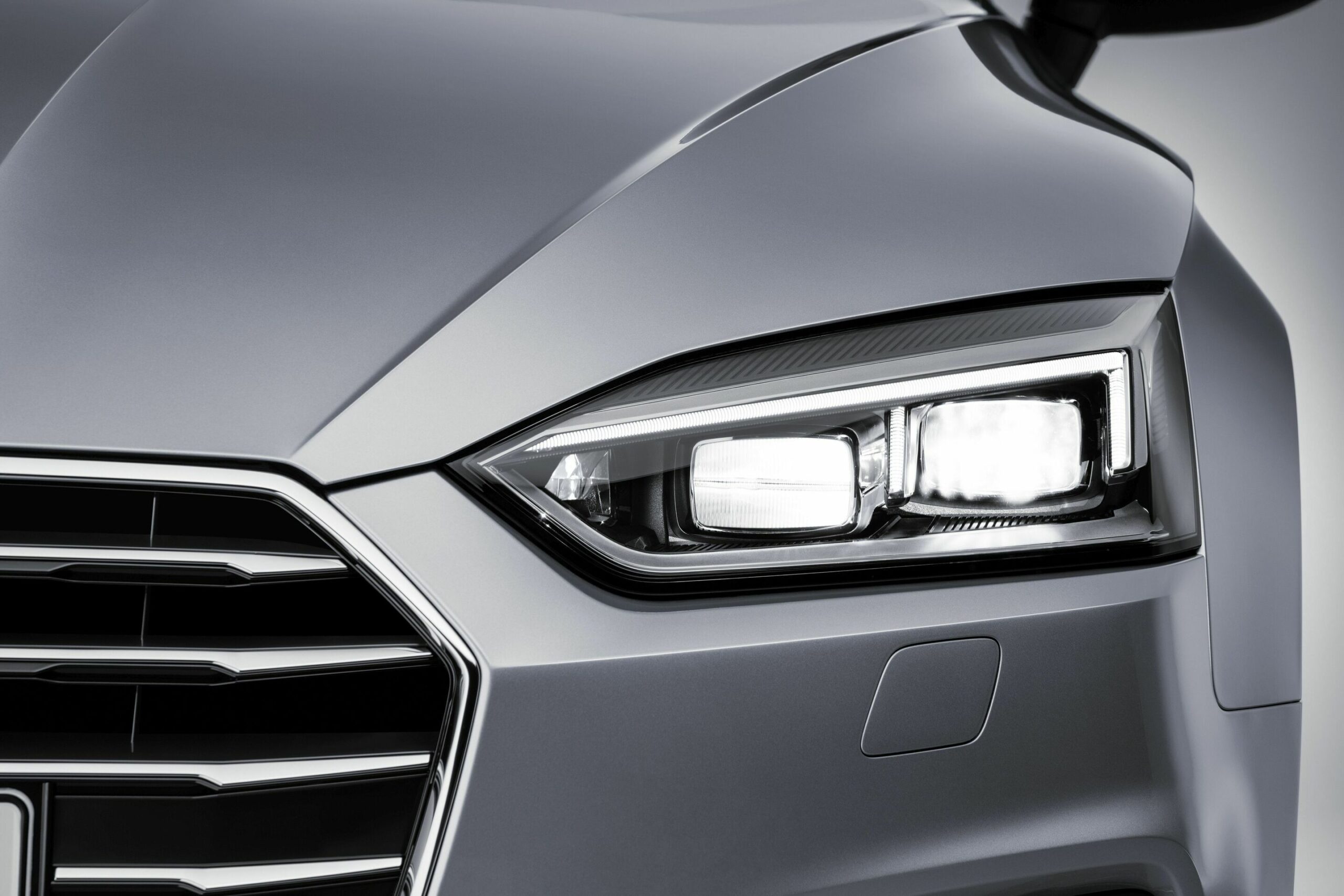
Matrix LED headlights are the one premium lighting technology that genuinely changes how safely you drive at night. They split the high beam into segments that switch off individually around other vehicles, so you can keep your main beams on without dazzling anyone. Laser headlights add extra high-beam range on top of LEDs, but they only work at highway speeds, and BMW has been phasing them out. OLED, despite the marketing, is not a headlight technology at all: carmakers use it for tail lamps and light signatures, not for lighting the road. For an Indian buyer, matrix or adaptive LED is the option worth paying for. Laser is a nice-to-have, and OLED is styling.
The quick answer: what each technology does
| Technology | Where it is used | What it does for you | Indian examples |
| LED (static) | Headlights on almost every luxury car | Bright, white, efficient low and high beams in a fixed pattern | Standard on most luxury cars |
| Matrix / adaptive LED | Headlights | High beam split into segments that switch off around other vehicles, guided by a camera | Audi Q8 and A8 L (HD Matrix LED) |
| Digital micro-mirror LED | Headlights | A matrix headlight with very fine control, able to project symbols on the road | Mercedes-Benz S-Class (Digital Light), Audi A8 L Technology (Digital Matrix LED) |
| Laser | Headlights, as a high-beam booster | Extra high-beam range at speed | Audi Q8 (laser high beam from 70 km/h) |
| OLED | Tail lamps and light signatures | Thin, evenly lit panels and customisable animations | Audi A8 L (standard OLED tail-lights), Audi Q8 (optional) |
Indian examples from Autocar India (A8 L, July 2022), Autocar Professional (S-Class, June 2021; Q8, August 2024) and Audi’s Q8 press release (September 2023).
Matrix LED headlights: the one that actually matters
A conventional headlight has two settings. Low beam is safe for other drivers and short on reach. High beam lights up the road and blinds everyone coming the other way. Most of us spend our night drives flicking between the two, usually too late.
A matrix headlight removes that compromise. When Audi introduced its Matrix LED system on the 2013 A8, each headlight’s high beam was made up of 25 individual segments that could be switched off, switched on, or dimmed one at a time, according to Audi’s technology portal. A camera recognises other cars, and the system switches off only the segments that would hit them. Everything else stays on high beam. In practice, the oncoming car drives through a moving dark box while the verges, the road ahead and anyone walking on the shoulder stay brightly lit.
Each brand has its own name for the idea. Audi calls it Matrix LED or HD Matrix LED, while BMW pairs its headlights with a camera-based system it calls Selective Beam. The principle is the same: a camera, a segmented high beam and software deciding which segments to switch off.
Why matrix headlights suit Indian roads
Our view is that matrix lighting earns its keep on the kind of night driving Indian luxury car owners do often: two-lane state highways and expressway approaches with patchy street lighting, a steady stream of oncoming trucks and buses, and the occasional unlit tractor, cyclist or animal on the shoulder. On a normal headlight, you either drive on low beam and see less, or keep flashing your high beam on and off. With a well-calibrated matrix system, you leave it in auto and get more light on the road without blinding the truck driver coming the other way.
There are limits. The system works by detecting other vehicles’ lights, so it cannot protect someone it doesn’t recognise. And in dense city traffic, with constant oncoming headlights and street lighting, the high beam will rarely be active at all, which means you get little benefit from it in town. If almost all your driving is inside Mumbai or Bengaluru, matrix lighting is a smaller win than it is for someone who regularly drives Delhi to Jaipur after dark.
Digital headlights: matrix lighting taken to the extreme
The most advanced headlights replace a few dozen segments with a micro-mirror chip, the same idea used in cinema projectors. Mercedes-Benz’s Digital Light directs the light from three LEDs through 1.3 million micro-mirrors in each headlamp, giving more than 2.6 million pixels across the car, according to Mercedes-Benz’s EQS Digital Light release. Audi’s Digital Matrix LED, offered on the A8 L Technology in India, works on the same micro-mirror principle, according to Autocar India.
That resolution lets the headlights do more than avoid glare. Mercedes says Digital Light can project guide lines onto a narrow lane, warning symbols for roadworks, a spotlight on a pedestrian detected at the roadside, and lane-change warnings linked to its driver-assistance systems. The catch is regulation: Mercedes says the permitted projection functions vary by country, and the car uses geo-fencing to adjust Digital Light to local rules. If projections matter to you, ask the dealer which ones are actually enabled on India-spec cars.
For most buyers, digital headlights are a feature you get because you bought an S-Class, not a reason to buy one. The core benefit, a glare-free high beam, is the same one a good matrix system already gives you.
Laser headlights: impressive, specialised and fading out
Laser headlights are less dramatic than they sound. Laser diodes fire a tightly focused beam onto a phosphor material, which converts it into very bright white light. BMW, which put the first laser headlights into production on the i8 in 2014, said the laser boost gave a high-beam range of up to 600 metres, double that of an LED high beam, and was about 30 percent more energy-efficient than LED light.
Two things limit how much that matters in daily use:
- The laser only supplements the high beam. The low beam, which you use most of the time, is still LED. On the current Audi Q8, Audi says the laser high beam becomes active from 70 km/h. Below that, you are driving on LEDs like everyone else.
- It is expensive and on its way out at BMW. BMWBLOG reported in December 2024 that BMW has been dropping laser lights from its range, largely because US rules cap headlight intensity at a level that cancels out the laser’s advantage there. The same report cited an $8,000 bill, including labour, to replace one damaged laser headlight on a BMW M8 in the US.
There is also an Indian regulatory question. In August 2026, the Ministry of Road Transport and Highways issued a draft notification proposing, among other changes, to cut the maximum permitted intensity for high-intensity headlamps on four-wheelers from 2.25 lakh candela to 1.5 lakh candela, according to PSU Watch and The Daily Pioneer. It is a draft, not a final rule, and the reports don’t mention laser lighting. But 1.5 lakh candela is the same 150,000-candela figure BMWBLOG cites as the US limit, so if the cap is notified as drafted, the range advantage of laser high beams on Indian roads could narrow. Treat that as our reading of a draft, and check for the final notification.
Our verdict: buy a car with laser lighting if it comes as part of the package you want, as it does on the Audi Q8. Don’t stretch your budget or choose one model over another for it.
OLED: brilliant tail lamps, not headlights
OLED (organic light-emitting diode) panels emit light evenly across their whole surface, so they need no reflectors or light guides. That makes them thin, very uniform to look at, and easy to divide into animated segments. What they don’t do is produce the concentrated, long-throw beam a headlight needs. We could not find a production car that uses OLED for its main headlights.
Instead, OLED has become the premium tail-lamp technology. Audi’s timeline, from its 2023 Q6 e-tron lighting release:
- 2016: first OLED rear lights at Audi, on the TT RS.
- 2020: digital OLED rear lights on the Q5, with selectable light signatures.
- 2022: digital OLED rear lights standard on the A8.
- 2023 onwards: second-generation digital OLED rear lights with 360 segments across six panels, able to display warning symbols to cars behind.
BMW used OLED tail lights and rear indicators on its M4 Concept Iconic Lights in 2015. In India, Autocar India reported OLED tail-lights as standard on the 2022 A8 L facelift, and Audi’s Q8 release lists OLED rear lights as an option with a proximity function that lights every segment when a car comes within two metres of the parked Q8.
So when a brochure or a salesperson pitches “OLED lights”, understand what you are paying for: a distinctive rear signature and some clever animations. That is a perfectly good reason to like a car. It will not help you see the road.
Matrix LED vs laser vs OLED: which should you pay for?
| Matrix / adaptive LED | Laser | OLED | |
| Helps you see at night | Yes, a lot | Yes, at highway speed on high beam | No |
| Reduces glare for others | Yes | Only with a matrix-style system controlling it | Not relevant |
| Useful in city traffic | A little | Rarely | Visibility to cars behind only |
| Useful on highways at night | Very | Yes | No |
| Future-proof in India | Yes | Uncertain if intensity caps tighten | Yes |
| Our verdict | Worth paying for | Nice to have | Styling |
What to check on a used car with advanced headlights
Matrix, laser and OLED units are sealed assemblies full of electronics, so a fault or a minor accident usually means replacing the whole unit rather than a bulb. We could not find reliable published Indian prices for matrix or laser headlamp replacement, but lamp parts on luxury cars are expensive even without them: a Team-BHP owner reported being quoted Rs 38,000, and then Rs 56,000, for a single broken tail light on a Lexus ES. Expect advanced headlights to cost considerably more.
If you are buying a pre-owned car with these systems:
- Test the automatic high beam on an unlit road at night, with traffic coming the other way. You should see dark zones following oncoming cars rather than the whole beam dipping.
- Look for warning messages on the instrument cluster related to lighting or the front camera, and ask the brand’s workshop to scan the car for stored lighting faults.
- Check for condensation, cracks, or mismatched units. A headlamp that looks newer than the other may mean an accident repair.
- Ask for a written quote from the brand’s workshop for a replacement headlamp before you negotiate, and check your insurance. Our guide to must-have insurance add-ons for luxury cars explains why depreciation cover matters on expensive parts like these.
Our used luxury car inspection checklist covers the rest of a pre-purchase check.
Our verdict
If you are choosing between variants or between two cars, rank lighting like this: matrix or adaptive LED first, everything else a distant second. It makes night driving on Indian highways safer and less tiring, which is more than any of the other three can claim. Digital micro-mirror headlights are matrix lighting with extra features. Laser is a highway range booster that BMW is already moving away from, and India’s draft rules could blunt it further. OLED is for the back of the car and for looks.
You can see current prices for cars with these systems, such as the Audi Q8 and the Mercedes-Benz S-Class, on Motozite.
FAQ
What is the difference between matrix LED and normal LED headlights?
Normal LED headlights have fixed low and high beams. Matrix LED headlights split the high beam into individually controlled segments and use a camera to switch off only the segments that would dazzle other vehicles. That lets you drive with more of the high beam on for longer without blinding oncoming traffic.
Are laser headlights better than matrix LED headlights?
Not in everyday driving. Laser headlights add high-beam range, up to 600 metres according to BMW, but they work only on high beam and, on the Audi Q8, only from 70kph. Matrix LED headlights improve visibility in far more situations, and laser units are usually combined with matrix-style control anyway.
Do any cars have OLED headlights?
We could not find any production car that uses OLED for its main headlights. Carmakers such as Audi and BMW use OLED for tail lamps, rear indicators and customisable light signatures, because OLED panels give an even, thin light that can be animated, not the long-throw beam a headlight needs.
Which luxury cars in India have matrix LED headlights?
Examples include the Audi Q8 and A8 L, which use HD Matrix LED headlights, while the A8 L Technology and the Mercedes-Benz S-Class use micro-mirror digital headlights. Equipment changes with model updates and variants, so check the specification sheet for the exact variant you are considering.
Are matrix headlights useful in India?
Yes, most of all on highways and state roads at night with oncoming traffic and little street lighting, where they let you keep more of the high beam on without dazzling other drivers. In heavy city traffic, the high beam is rarely active, so the benefit is smaller.
Will India ban very bright headlights?
In August 2026, the transport ministry issued a draft notification proposing to cut the maximum intensity of high-intensity headlamps on four-wheelers from 2.25 lakh to 1.5 lakh candela, among other changes aimed at reducing glare. It is a proposal, not a final rule, so check for the final notification before drawing conclusions.
