
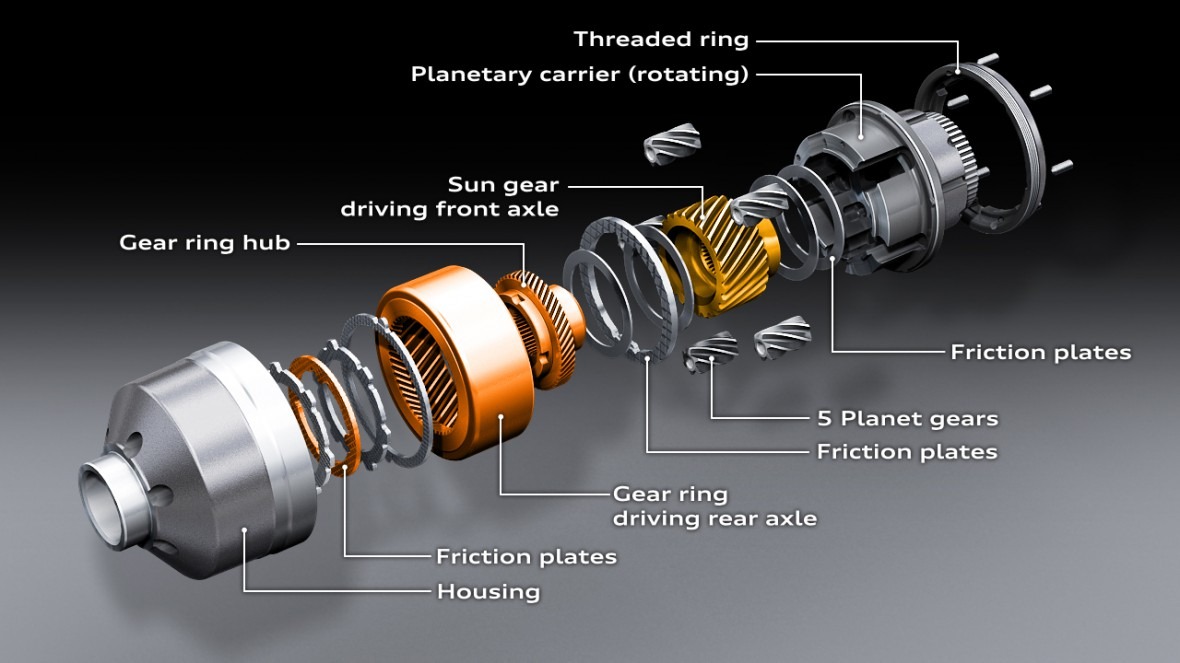
Quattro, xDrive and 4MATIC are the all-wheel-drive brand names of Audi, BMW and Mercedes-Benz, and each name covers more than one kind of hardware. BMW’s xDrive is a rear-biased system that uses an electronically controlled clutch to send drive to the front axle. Mercedes’ 4MATIC on its bigger cars uses a centre differential with a fixed 45:55 front-to-rear split, while its compact cars run front-wheel drive with a clutch that adds rear drive when needed. Audi’s quattro ranges from a mechanical self-locking centre differential (40:60) to “quattro ultra”, which can disconnect the rear axle entirely to save fuel. For most Indian city driving, the differences are small. What matters more is that many popular luxury cars sold here, including the BMW X1 and Audi A6, have no all-wheel drive at all.
The short version: three badges, six kinds of hardware
The badge on the boot tells you the brand, not the mechanism. Here is what sits underneath, based on each manufacturer’s own technical material.
| System | How it splits drive | Normal split (front:rear) | Typical use |
| Audi quattro, self-locking centre differential | Mechanical planetary or crown-gear centre differential that locks progressively when an axle slips | 40:60 | Larger longitudinal-engine Audis and RS models |
| Audi quattro with ultra | Clutch at the gearbox and a decoupling clutch at the rear axle; rear driveline can switch off | 100:0 when cruising, rear engages when needed | Many longitudinal-engine Audis; Audi names the A5, A6 and Q5 on its current platform |
| Audi quattro, transverse engine | Electronically controlled multi-plate clutch ahead of the rear differential | Mostly front | Compact Audis such as the A3 and TT; the Q3 shares this transverse-engine layout |
| BMW xDrive | Electronically controlled multi-plate clutch in the transfer case, working with the stability control | Rear-biased | Almost every BMW sold with all-wheel drive |
| Mercedes 4MATIC, longitudinal | Centre differential with a fixed split and a light pre-lock clutch | 45:55 | C-, E-, S-Class and the SUVs built on them |
| Mercedes 4MATIC, transverse and AMG 4MATIC+ | Clutch-based, fully variable | Front-biased on compact cars; up to 100 percent rear on 4MATIC+ | GLA, CLA and A-Class (front-biased); AMG E 63 and similar (4MATIC+) |
Two things jump out. First, “permanent all-wheel drive” in a brochure does not tell you which of these you have. Autocar India’s specification page for the new Audi Q3 describes its quattro as permanent, yet Audi’s own material says its transverse-engine quattro works through a clutch that normally sends most power to the front. Second, the same 4MATIC badge sits on a GLA 220d and a GLC 300, and they drive their rear wheels in very different ways.
How Audi quattro works
Audi has the longest history here. The original Audi quattro made its debut at the Geneva Motor Show in spring 1980, with permanent all-wheel drive in a production road car. Since then the name has been stretched across three distinct systems.
The self-locking centre differential. This is the classic quattro. On longitudinal-engine cars, a planetary centre differential sends 40 percent of the drive to the front and 60 percent to the rear in normal driving. If one axle starts to slip, the geared design creates internal friction that locks the differential progressively, sending up to 60 percent forward or up to 80 percent rearward, according to Audi’s technology portal. Audi’s crown-gear version on cars such as the RS 5 and A7 can send up to 70 percent to the front or 85 percent to the rear. It is purely mechanical, always on and reacts without waiting for a sensor. Enthusiasts like it for exactly that reason.
quattro with ultra. Introduced in 2016 on the A4 allroad, ultra is Audi’s answer to fuel economy rules. A multi-plate clutch at the gearbox output and a second decoupling clutch in the rear differential can both open, disconnecting the propeller shaft and rear driveline so the car runs as a front-wheel drive. Audi says the system reads steering angle, throttle, lateral and longitudinal acceleration, road grip and driving style to predict about half a second ahead when all-wheel drive will help, and can fully re-engage in about 200 milliseconds. Under hard acceleration on a dry road, Audi says more than 70 percent of the torque can go to the rear.
Transverse-engine quattro. On compact Audis with the engine mounted sideways, a hydraulically actuated multi-plate clutch sits at the end of the propeller shaft, just ahead of the rear differential. Audi says it normally sends most power to the front axle and, as clutch pressure rises, can shift torque rearward steplessly, up to 100 percent in some cases. Audi first used it on the TT and A3 quattro in 1998.
How BMW xDrive works
BMW showed its first all-wheel-drive car, the 325i “Allrad” (later called the 325iX), in 1985. It used viscous couplings and a fixed 37:63 front-to-rear split. The xDrive name arrived in 2003 on the X3 and X5, and BMW India’s launch release for the current X3 notes that the first-generation X3 was the first car to offer it.
xDrive uses an electronically controlled multi-plate clutch in the transfer case. Instead of waiting for a wheel to spin, it takes data from the stability control system, including steering angle, accelerator position and lateral acceleration, and adjusts how much drive goes to the front axle. BMW describes it as biased towards rear-wheel drive, so in normal driving a BMW with xDrive still steers and feels like a rear-driven car. On recent models, BMW says more drive goes rearward as you enter a corner, which is part of why an xDrive car feels keen to turn in.
BMW also uses the xDrive name on its front-wheel-drive-based models, starting with the 2 Series Active Tourer in 2014. On those cars the hardware is closer in principle to Audi’s and Mercedes’ transverse systems: front-biased with a clutch feeding the rear. In India this matters less than you might think, because the BMW X1 is currently sold only in front-wheel-drive sDrive form, according to Autocar India.
How Mercedes-Benz 4MATIC works
Mercedes showed 4MATIC at the Frankfurt Motor Show in 1985 and began deliveries on the W124 E-Class in spring 1987, initially on six-cylinder models only.
Longitudinal 4MATIC. On the C-, E- and S-Class and the SUVs built on them, Mercedes describes a centre differential with a fixed 45:55 front-to-rear split, supported by a light pre-lock clutch. Rather than moving torque between axles, it relies on the stability control’s traction system to brake a slipping wheel. The result is predictable and stable, which suits the way most Mercedes owners drive.
Transverse 4MATIC. On compact models like the GLA, Mercedes uses a fully variable system that runs largely as a front-wheel drive. A hydraulic multi-disc clutch in the rear differential sends drive to the back when needed. Mercedes’ own summary of the idea is “as often as necessary, as rarely as possible”.
AMG 4MATIC+. For performance models, AMG’s fully variable 4MATIC+ debuted on the E 63 for 2017. It can send up to 100 percent of drive to the rear wheels, and the E 63 S added a Drift Mode that pushes even more of the drive rearward for track use.
What about electric quattro, xDrive and 4MATIC?
On dual-motor EVs such as the BMW iX, Audi Q8 e-tron or Mercedes EQE SUV, the badge stays but the mechanics change completely. There is one motor on each axle and no propeller shaft or centre differential. Software decides how much each motor delivers, many times a second, and some can run on one motor alone when cruising to save energy. The traction is excellent and the response is faster than any mechanical system. Comparisons between the brands’ combustion systems don’t carry over to their EVs.
Which luxury cars in India have all-wheel drive?
This is where the badge debate meets reality. Several of India’s most popular luxury cars are sold without all-wheel drive. The table below is based on Autocar India’s specification pages as of September and October 2026.
| Car | All-wheel drive in India? |
| BMW X1 | No. Both variants (sDrive18i, sDrive18d) are front-wheel drive |
| BMW 3 Series | Only the M340i (xDrive); the long-wheelbase 330Li is rear-wheel drive |
| BMW X3 | Yes, xDrive on all variants |
| BMW X5 | Yes, xDrive on all variants |
| Audi A6 | No. Both 45 TFSI variants are front-wheel drive |
| Audi Q3 | Yes, quattro standard |
| Audi Q5 | Yes, all-wheel drive |
| Audi Q7 | Yes, all-wheel drive |
| Mercedes-Benz GLA | Only the 220d 4MATIC; the GLA 200 petrol is front-wheel drive |
| Mercedes-Benz C-Class | Only the AMG C 43 4MATIC and C 63 S E Performance (4MATIC+) |
| Mercedes-Benz E-Class LWB | Only the E 450 4MATIC and AMG E 53 (4MATIC+) |
| Mercedes-Benz GLC | Yes, 4MATIC on both the 300 and 220d |
Variant line-ups change often. Check the exact variant before you buy, new or used.
Do you need all-wheel drive in India?
Our view: for most luxury buyers in Indian cities, no. Front- or rear-wheel drive with good tyres handles everyday driving, and a chauffeur-driven A6 or 330Li gives up nothing by sending drive to one axle. All-wheel drive starts to earn its place in four situations.
- Hill driving and snow. Steep, broken climbs in Himachal, Uttarakhand or the North-East, especially in winter, are where AWD gives a real advantage when pulling away on loose or icy surfaces.
- Powerful cars. Getting 380hp or more onto the road cleanly, as in an X5 xDrive40i or M340i, is much easier through four wheels, particularly on a wet surface.
- Farmhouse roads, gravel and sand. Loose surfaces where a single driven axle would scrabble.
- Monsoon traction. AWD helps you pull away and accelerate on a wet road. It does not help you stop or corner, and it does nothing for water depth. Wading ability is about air intake height and ground clearance, not which wheels are driven.
What AWD costs you: more weight, a little more fuel, and more parts that need looking after. On a used AWD car, ask whether the transfer case, coupling or differentials have scheduled fluid changes in the service plan, and keep tyre wear even on all four corners. Mismatched tyres make the system work constantly, so check your owner’s manual before replacing only two.
Quattro vs xDrive vs 4MATIC: which is best?
None of them is a bad system, and you will rarely feel the differences in normal driving. They show up at the limit and in how each car feels.
- Pick xDrive if you want the car to feel rear-driven. BMW’s rear bias gives the most natural, playful steering feel of the three in normal driving.
- Pick a mechanical quattro if you want the most stable, predictable traction. The self-locking centre differential is always working and needs no prediction. It is the old-school choice, and still a very good one.
- Pick quattro ultra or a transverse system if efficiency matters more. Running mostly as a front-wheel drive saves fuel on long highway runs, and the rear axle is there when the road turns slippery.
- Pick longitudinal 4MATIC for calm, secure handling. The fixed 45:55 split suits a comfort-first luxury car, which is what most Mercedes buyers want.
The bigger decision is usually whether the variant you want has all-wheel drive at all. You can compare new luxury SUVs and check on-road prices by variant on Motozite, or browse pre-owned luxury SUVs listed by sellers across India. If you are comparing the mid-size SUVs, our BMW X5 vs Mercedes GLE vs Audi Q7 comparison covers the rest of the decision.
FAQs
What is the difference between quattro, xDrive and 4MATIC?
They are the all-wheel-drive brand names of Audi, BMW and Mercedes-Benz. BMW’s xDrive is rear-biased and uses an electronically controlled clutch to send drive forward. Mercedes’ longitudinal 4MATIC uses a centre differential with a fixed 45:55 split, and Audi’s quattro uses either a mechanical self-locking centre differential (40:60), a clutch-based system that can disconnect the rear axle (ultra), or a front-biased clutch on compact models.
Which is better, quattro or xDrive?
Neither is clearly better. Audi’s mechanical quattro is the more stable and predictable at the limit, while BMW’s rear-biased xDrive gives a more rear-driven, agile feel. In everyday Indian driving you will notice the car’s tyres and suspension far more than its all-wheel-drive system.
Is 4MATIC full-time all-wheel drive?
On Mercedes’ longitudinal cars such as the C-, E- and S-Class and their SUVs, yes: 4MATIC uses a centre differential with a 45:55 front-to-rear split. On compact models such as the GLA, 4MATIC runs largely as front-wheel drive and sends drive to the rear through a clutch when needed. AMG’s 4MATIC+ is fully variable and can send all the drive to the rear.
Does the BMW X1 have xDrive in India?
No. As of September 2026, Autocar India lists both BMW X1 variants sold in India, the sDrive18i petrol and sDrive18d diesel, as front-wheel drive. The X3, X5 and M340i come with xDrive.
Do you need all-wheel drive for Indian roads?
For most city driving, no. Front- or rear-wheel drive with good tyres is enough. All-wheel drive is worth having for hill driving and snow, loose surfaces like gravel or sand, and powerful cars that struggle to put their power down on wet roads. It does not help with braking or with driving through deep water.
What is quattro ultra?
quattro ultra is Audi’s efficiency-focused all-wheel drive, introduced in 2016. It can disconnect the propeller shaft and rear driveline so the car runs in front-wheel drive, then re-engage all-wheel drive in about 200 milliseconds. Audi says it predicts about half a second ahead when all-wheel drive will be needed.
