
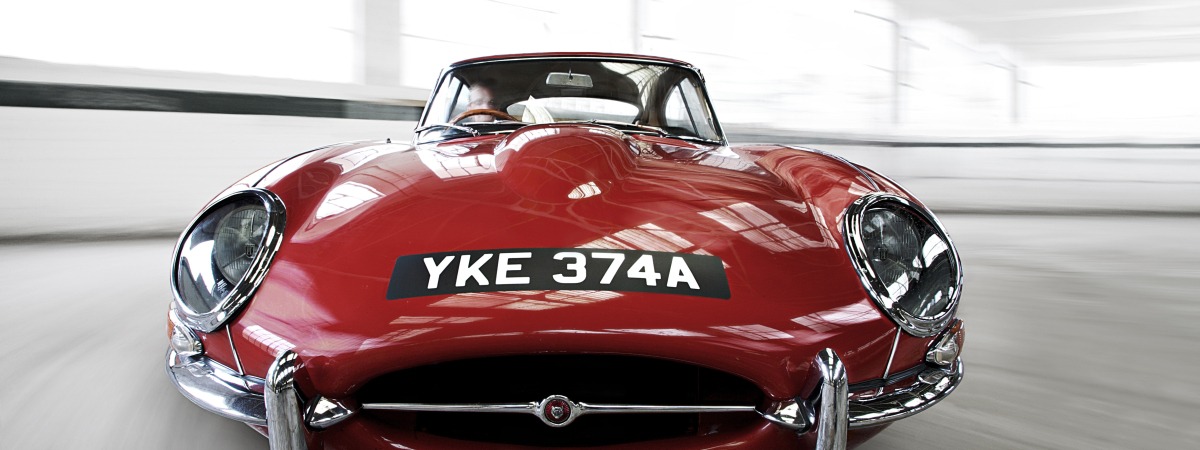
Jaguar began in 1922 as the Swallow Sidecar Company in Blackpool, founded by William Lyons and William Walmsley, and first used the Jaguar name on a car in 1935. It changed its company name to Jaguar Cars in 1945, built the XK120 and E-Type, won Le Mans seven times, and passed through British Leyland, a stock market flotation and Ford before Tata Motors bought it, with Land Rover, in 2008. Since then Jaguar has been Indian-owned. In 2026 it is in the middle of its boldest reset yet: the last petrol Jaguar was built in December 2025, and its first car of the new electric era, the Type 01, was revealed in New York on 7 October 2026.
Lyons had a rule for his cars, which Jaguar quoted back to the world when it relaunched in 2024: they should be a “copy of nothing”. Read Jaguar’s history against that rule and a pattern appears. The brand was at its best when it ignored everyone else, and in trouble whenever it tried to fit in.
Jaguar timeline at a glance
| Year | Milestone |
| 1922 | Swallow Sidecar Company founded in Blackpool by William Lyons and William Walmsley |
| 1928 | Business moves to Coventry |
| 1935 | SS Jaguar 2½ litre saloon, the first car to carry the Jaguar name |
| 1945 | SS Cars renamed Jaguar Cars |
| 1948 | XK120 and the XK engine launched |
| 1949 | XK120 reaches 132.596mph over a flying mile at Jabbeke, Belgium |
| 1951 to 1957 | Five Le Mans wins with the C-type and D-type |
| 1956 | William Lyons knighted |
| 1960 | Jaguar buys Daimler |
| 1961 | E-type unveiled at Geneva |
| 1968 | XJ6 launched |
| 1972 | XJ12 launched; Sir William Lyons retires |
| 1984 | Jaguar floated on the stock market |
| 1988 and 1990 | Sixth and seventh Le Mans wins (XJR-9, XJR-12) |
| 1990 | Ford completes its purchase of Jaguar |
| 2008 | Tata Motors buys Jaguar Land Rover from Ford for US$2.3 billion |
| 2011 | JLR opens its Pune assembly plant |
| 2019 | I-Pace wins World Car of the Year |
| 2024 | New brand identity and Type 00 concept revealed in Miami |
| 2025 | Final F-Pace, the last combustion-engined Jaguar, built in December |
| 2026 | Type 01 electric GT revealed in New York on 7 October |
Sources: Jaguar Daimler Heritage Trust, JLR media, ACO (24 Hours of Le Mans), Tata newsroom.
1922 to 1945: from sidecars to SS Jaguar
The company that became Jaguar started with motorcycle sidecars. William Lyons, a young motorcyclist, went into partnership with his neighbour William Walmsley in Blackpool in 1922, according to the Jaguar Daimler Heritage Trust. Their fathers each guaranteed £500 of a £1,000 loan to get them going.
Sidecars led to car bodies, and in 1928 the business moved to Coventry, the centre of the British motor industry. Walmsley left in 1934, leaving Lyons in sole charge of what was then S.S. Cars Ltd. In September 1935 the company launched the SS Jaguar 2½ litre saloon, the first model to wear the Jaguar name.
The SS initials did not survive the Second World War, when they had taken on an association no carmaker would want. In March 1945 Lyons announced the change of name to Jaguar Cars.
What stands out from these years is how early Lyons settled on the formula Jaguar would use for decades: cars that looked far more expensive than they were. That gap between price and presence was Jaguar’s first real innovation, and it was a design idea, not an engineering one.
1948 to 1961: the XK120, Le Mans and the E-type
Then Jaguar became fast. The XK120 and its new XK straight-six engine were launched at the 1948 Motor Show. In May 1949, on a closed motorway at Jabbeke in Belgium, a lightly modified XK120 averaged 132.596mph over a flying mile. Motor Sport magazine reported it at the time as the highest speed yet reached by a production car.
Racing followed, and Jaguar treated Le Mans as its shop window. The C-type won first time out in 1951 and again in 1953. With the D-type, the total reached five wins by 1957, the last of them by privately entered Ecurie Ecosse cars after the factory itself had stepped back from racing. Lyons was knighted in the 1956 New Year Honours, and in 1960 Jaguar bought the Daimler Motor Company.
On 15 March 1961 came the car that still defines the brand. The E-type was presented to the press in Geneva, shaped by the aeronautical engineer Malcolm Sayer and capable of 150mph. Demand for demonstration runs was so intense that Lyons ordered test driver Norman Dewis to drive a second car through the night from Coventry to Switzerland, according to JLR. It cost £2,256 in Britain at launch, including tax and optional wire wheels. More than 70,000 were sold over 14 years, and JLR says one is in the permanent collection of New York’s Museum of Modern Art.
This is the “copy of nothing” rule at its purest. The E-type looked like nothing else on the road, went faster than cars that cost far more, and borrowed directly from Jaguar’s own racing cars. No Jaguar since has matched that combination.
1968 to 1989: the XJ, British Leyland and Egan
The XJ6 saloon arrived in 1968 and became Jaguar’s other great template: a low, wide, quiet luxury car that rode better than its rivals. The V12 XJ12 followed in 1972, the year Sir William Lyons retired. He died in February 1985.
Before that, Jaguar had spent years inside the British Leyland group. The Heritage Trust sums up John Egan’s career at Jaguar as taking it from British Leyland to Ford ownership. In 1984 Jaguar was floated on the stock market and, by the Trust’s account, went on to considerable success as an independent company. Its racing revival came at the same time. The Silk Cut XJR-9 won Le Mans in 1988, driven by Johnny Dumfries, Jan Lammers and Andy Wallace, and the XJR-12 led a one-two in 1990.
1990 to 2008: the Ford years
Independence didn’t last. Ford, which paid £1.6 billion according to Automotive News Europe, completed its purchase of Jaguar at the start of 1990. It later bought Land Rover as well, for £1.7 billion.
The Ford era brought money, factories and shared engineering, but not a lasting business. Automotive News Europe estimated in 2008 that Jaguar and Land Rover had cost Ford about €13 billion in total since 1989. In March 2008 Ford agreed to sell both brands to Tata Motors for US$2.3 billion in cash, and also put about US$600 million into the Jaguar Land Rover pension plans. The deal closed on 2 June 2008.
Our view: Ford’s problem was not a lack of investment. It was that a big-company Jaguar kept being asked to fit into segments and price points defined by its German rivals. That is the opposite of what Lyons built, and the balance sheet showed it.
2008 to 2024: Tata ownership and the Indian connection
For Indian buyers, this is where Jaguar’s story becomes partly Indian. Tata kept JLR’s leadership, design studios and plants in Britain, but brought the brands properly into India. JLR opened its first Indian showroom in 2009 and inaugurated an assembly plant in Pune in May 2011, starting with the Land Rover Freelander 2. In January 2013 it began selling a Pune-built Jaguar XF with a 2.2-litre diesel engine, priced from Rs 44.5 lakh ex-showroom in Mumbai.
The best car of the Tata era, in our view, was the I-Pace. It was Jaguar’s first electric car and in April 2019 it won three World Car Awards at once: World Car of the Year, World Car Design of the Year and World Green Car. It was a genuine “copy of nothing”, an electric SUV from a traditional luxury maker before the Germans had one on sale.
The Indian market didn’t reward it. Autocar Professional reported that Jaguar sold only 31 I-Paces in India in FY2024, against 738 BMW iXs, and by July 2024 Jaguar India had stopped taking orders for it. The F-Type sports car had gone too, leaving the F-Pace as Jaguar’s only model on sale here.
2024 to 2026: the reset and the Type 01
As its old range wound down, Jaguar did something few established luxury brands would risk: it threw away its old identity and started again. On 3 December 2024, at Miami Art Week, it revealed the Type 00 concept, a long-bonneted electric GT in Miami Pink and London Blue, and a new design philosophy it calls exuberant modernism. Its “Copy Nothing” campaign was named after Lyons’s own phrase.
The reset was not smooth. A cyber attack on 1 September 2025 forced JLR to shut down its systems, and it built no cars anywhere for about five weeks, Autocar reported. On 19 December 2025 the last F-Pace left the Solihull plant, ending Jaguar’s combustion-engine era.
On 7 October 2026 Jaguar revealed the production car in New York. Here is what Jaguar and its parent company have confirmed about the Type 01:
| Jaguar Type 01 | Figure |
| Body | Four-door electric grand tourer |
| Motors | Three, all-wheel drive |
| Power | More than 1,000PS (Jaguar’s most powerful road car) |
| Battery | 118kWh usable, 850V architecture |
| Range | Up to 720km (Jaguar’s claim) |
| Fast charging | About 320km of range in 13 minutes on a 350kW DC charger |
| 0-100km/h | 3.2 seconds |
| Built at | Solihull, UK, from 2027 |
| Orders and deliveries | Orders open early 2027; deliveries later in 2027 |
Sources: Tata newsroom (7 October 2026) and Motown India (7 October 2026). Range and charging figures are manufacturer claims.
Motor1 reported in May 2026 that the Type 01 would start well above US$100,000, which makes it a very different proposition from the Rs 45 to 75 lakh Jaguars Indian buyers knew. For a deeper look at the car itself, see our Jaguar Type 01 electric GT review, and for the strategy behind it, our analysis of whether Jaguar can bring back its magic in the EV era.
Jaguar in India today
As of October 2026, Autocar India’s Jaguar page says the brand has no models officially on sale in India, with the XE, XF, E-Pace, I-Pace and F-Type all listed as discontinued. It expects the Type 01 here around mid-2027. Jaguar has not announced an Indian price.
If you want a Jaguar in India before then, the pre-owned market is the only route. A few practical points:
- Service still runs through JLR dealers. JLR India’s five-year service plan, announced in June 2024, applies across what it calls its House of Brands. Confirm with your nearest JLR workshop how it supports the specific model and engine you are buying. Our comparison of Audi, Volvo, Lexus and JLR service packages covers what JLR’s packages cost.
- Parts for discontinued models. Check with the dealer how quickly common parts for that car arrive. An orphaned model can mean longer waits.
- Resale. With no new Jaguars on sale, demand for used ones is thin, which makes them cheap to buy and slow to sell. Price that into your plans.
You can browse pre-owned luxury SUVs and pre-owned luxury sedans listed on Motozite. For the story of how Tata turned JLR around as a business, read our piece on how Tata Motors turned Jaguar Land Rover into a global success.
What Jaguar’s history tells you about its future
- Its best cars were its least conventional. The SS Jaguar, XK120, E-Type, original XJ, and I-Pace all did something rivals weren’t doing. Its weakest years came when it chased the Germans on their own terms.
- Owners have always been the variable. Lyons, British Leyland, the stock market, Ford, Tata. Each changed what Jaguar was allowed to be. Tata has now backed the most radical version yet.
- The Type 01 is a return to Lyons’s rule, on purpose. Whether a Rs 2 crore-plus electric GT is the right way to apply it is the open question. We think the logic is sound, because Jaguar could not win a price war in the segments it has left. The execution, and whether buyers follow, will decide it.
If brand histories are your thing, read our history of Ferrari and history of Lamborghini.
FAQ
Who founded Jaguar and when?
Jaguar was founded as the Swallow Sidecar Company in Blackpool in 1922 by William Lyons and William Walmsley. The first car to carry the Jaguar name was the SS Jaguar 2½ litre saloon of 1935, and the company was renamed Jaguar Cars in 1945.
Who owns Jaguar now?
Jaguar is part of Jaguar Land Rover (JLR), which India’s Tata Motors bought from Ford for US$2.3 billion. The deal was announced in March 2008 and completed on 2 June 2008.
Why did Jaguar drop the SS name?
The company traded as SS Cars from the 1930s, and by the end of the Second World War the initials were widely associated with the Nazi SS. In March 1945 William Lyons announced that the company would be renamed Jaguar Cars.
How many times has Jaguar won Le Mans?
Seven. Jaguar won five times between 1951 and 1957 with the C-type and D-type, then again in 1988 with the XJR-9 and in 1990 with the XJR-12.
Is Jaguar still sold in India?
As of October 2026, Autocar India lists no Jaguar models officially on sale in India. The F-Pace, Jaguar’s last petrol model, ended production in December 2025. Autocar India expects the new Type 01 electric GT to arrive around mid-2027; Jaguar has not announced an Indian price.
What is the Jaguar Type 01?
The Type 01 is Jaguar’s first production car of its new all-electric era, revealed in New York on 7 October 2026. It is a four-door grand tourer with three motors, more than 1,000PS and a claimed range of up to 720km. It will be built in Solihull, with orders opening in early 2027.
